The baseball card market, much like the diamond itself, is a hallowed ground where nostalgia and investment intertwine like the threads of a vintage wool uniform. Among the pantheon of sluggers whose cardboard likenesses still command attention, José Canseco’s cards occupy a peculiar niche—one that blends the raw power of his 1980s heyday with the modern collector’s quest for the unconventional. In 2025, as the hobby evolves beyond the rigid confines of PSA 10s and pristine rookies, Canseco’s cards endure as relics of a bygone era, their value oscillating like a fastball mid-flight. But are they still worth collecting? The answer lies not in the cold calculus of market trends, but in the intangible magic of baseball’s most electrifying personalities.
The Canseco Phenomenon: A Card That Punch-Throughs History
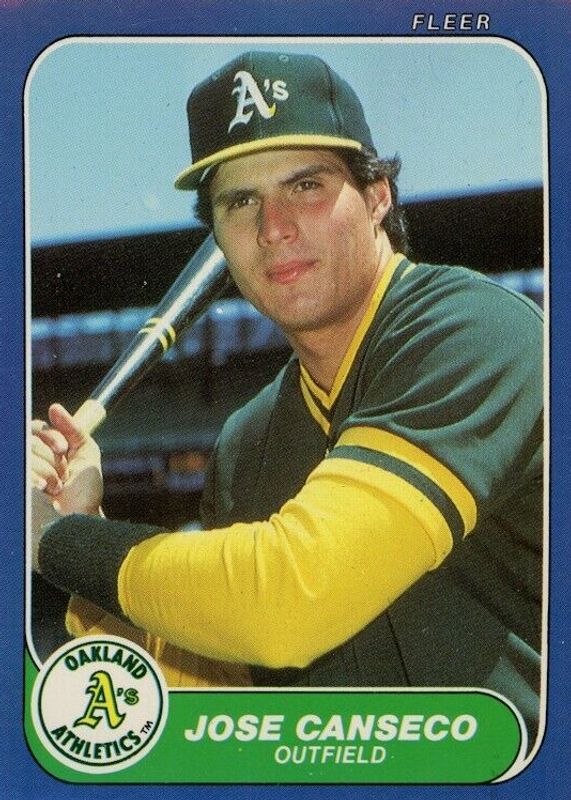
José Canseco wasn’t just a baseball player; he was a cultural earthquake, a seismic shift in how the game was perceived and consumed. His 1988 MVP season, where he became the first player in history to record 40 home runs and 40 stolen bases, wasn’t merely a statistical marvel—it was a statement. The Fleer Update card from 1986, with its stark, almost austere design, captures him in the embryonic stages of his dominance, a young Cuban exile poised to redefine the power-speed duality. This card isn’t just cardboard and ink; it’s a time capsule of an era when baseball’s aesthetic was raw, unfiltered, and unapologetically bold.
What makes Canseco’s cards so compelling is their duality. They’re not the pristine, airbrushed perfection of a Derek Jeter rookie or the pristine symmetry of a Mike Trout card. Instead, they bear the marks of authenticity—off-center printing, slightly faded colors, the faintest hint of wear that whispers of a collector’s hands cradling them decades ago. In a market obsessed with perfection, Canseco’s cards offer something far more valuable: character. They’re the baseball equivalent of a well-worn leather glove, each crease telling a story of games played, autographs sought, and dreams chased.
The Market’s Whims: Why Canseco’s Cards Defy the Odds
The baseball card market is a fickle beast, swayed by the winds of nostalgia, player legacies, and the ever-shifting tides of pop culture. Yet, Canseco’s cards have demonstrated a resilience that borders on the mythic. While his contemporaries like Mark McGwire and Sammy Sosa saw their cards surge in value during the steroid era’s heyday, Canseco’s market has remained a steady undercurrent, undulating rather than crashing. This isn’t the stuff of overnight millionaires; it’s the slow burn of a collector’s treasure, one that rewards patience over impulsivity.
Part of this endurance stems from Canseco’s polarizing legacy. He’s not just a player; he’s a lightning rod for debate. Was he a Hall of Famer robbed by the era’s politics, or a cautionary tale of unchecked ambition? This duality injects his cards with a narrative depth that transcends mere statistics. A collector isn’t just buying a piece of cardboard; they’re investing in a conversation, a debate, a piece of baseball’s most contentious chapter. In 2025, as the steroid era’s legacy continues to be dissected, Canseco’s cards serve as both relics and reminders—a tangible link to a time when the game’s boundaries were being redrawn in real time.
The market for Canseco’s cards is also buoyed by the rise of “flawed” collecting. Gone are the days when only pristine, gem-mint specimens held value. Today, collectors crave imperfection—the misprints, the off-center cuts, the cards that bear the scars of time. Canseco’s cards, with their occasional printing errors and vintage wear, fit this new paradigm perfectly. They’re not just collectibles; they’re artifacts, each one a unique fingerprint of the past.
The Ozzie Conundrum: The Forgotten Twin’s Unexpected Allure
While José Canseco’s cards bask in the spotlight, his lesser-known twin, Ozzie Canseco, has quietly carved out his own niche in the collector’s world. Ozzie’s cards, often overshadowed by his brother’s larger-than-life persona, offer a fascinating counterpoint—a glimpse into the parallel lives of two men who shared the same genetic code but divergent paths. His baseball cards, though less sought-after, possess a quiet charm, a testament to a career that, while not as storied, is no less a part of the Canseco legacy.

What makes Ozzie’s cards intriguing is their rarity. Unlike José, who was a household name, Ozzie’s career was a series of brief stints and minor-league detours. His cards, therefore, are harder to come by, especially in high-grade condition. For the astute collector, this presents an opportunity—a chance to acquire a piece of baseball history that hasn’t yet been commodified into oblivion. Ozzie’s cards are the baseball equivalent of a hidden gem, a secret waiting to be uncovered by those who appreciate the game’s quieter narratives.
There’s also a certain poetic justice in collecting Ozzie’s cards. In a hobby often dominated by the flashy and the famous, his cards offer a moment of reflection—a reminder that baseball’s beauty lies not just in the home runs and the MVPs, but in the journeymen, the bit players, the men who toiled in the shadows. Ozzie’s cards are a tribute to the unsung, a small but meaningful rebellion against the cult of personality that so often defines sports collecting.
The Investment Angle: Is It Worth the Gamble?
For those who view baseball cards through the lens of investment, Canseco’s cards present a conundrum wrapped in a riddle. On one hand, his market has shown signs of growth, particularly among niche collectors who appreciate his cultural impact. On the other, his cards lack the liquidity of a Mike Trout or a Mickey Mantle, making them a riskier proposition. The key to navigating this market lies in understanding its rhythms—recognizing that Canseco’s value isn’t tied to the ebb and flow of the broader hobby, but to the ebb and flow of his legacy.
One strategy for potential investors is to focus on specific subsets of Canseco’s cards. The 1986 Fleer Update, for instance, has seen steady appreciation, particularly in lower-grade conditions where its vintage charm shines. Similarly, his autographed cards—especially those signed in the early years of his career—hold a unique appeal. These aren’t just collectibles; they’re signed contracts with history, each autograph a personal endorsement of a moment frozen in time.
Another consideration is the role of grading in Canseco’s market. While high-grade PSA 10s command premium prices, there’s a growing appreciation for raw, ungraded cards. The market’s shift toward “flawed” collecting means that even cards with minor defects can hold significant value, provided they possess a compelling backstory or rarity. For the savvy collector, this opens up a world of opportunity—one where the pursuit of perfection takes a backseat to the pursuit of authenticity.
The Cultural Zeitgeist: Why Canseco’s Cards Still Matter
Baseball cards are more than just investments or hobbies; they’re cultural artifacts, each one a snapshot of the era in which it was produced. Canseco’s cards, with their bold designs and unapologetic energy, embody the spirit of the 1980s—a decade of excess, rebellion, and unbridled ambition. They’re a visual shorthand for a time when baseball was as much about spectacle as it was about sport, when players were as likely to be featured on the cover of *Sports Illustrated* as they were in the box scores.
In 2025, as the hobby continues to evolve, Canseco’s cards serve as a bridge between the past and the present. They remind us that collecting isn’t just about chasing the next big thing; it’s about preserving the stories that define us. Whether it’s the raw power of his rookie cards or the quiet resilience of Ozzie’s, Canseco’s cards offer a connection to a bygone era—a chance to hold a piece of history in your hands and feel the weight of what it represents.
For those who collect with their hearts as much as their wallets, Canseco’s cards are a treasure trove. They’re the baseball equivalent of a well-worn mitt, each crease and scuff telling a story of games played, heroes admired, and legacies forged. In a market that often prioritizes the new over the nostalgic, Canseco’s cards stand as a testament to the enduring power of baseball’s most electrifying personalities.
The baseball card market, much like the game itself, is a place of endless possibility. It’s where the past and present collide, where the value of a card isn’t just measured in dollars but in the stories it tells and the memories it preserves. José Canseco’s cards, with their bold designs and unapologetic energy, are more than just collectibles—they’re a celebration of a time when baseball was as much about spectacle as it was about sport. In 2025, as the hobby continues to evolve, Canseco’s cards endure as relics of a bygone era, their value not just in their rarity, but in the intangible magic of the man they depict. For those who collect with passion, they remain a worthy pursuit—a chance to own a piece of baseball history that punches through the noise of the modern market.