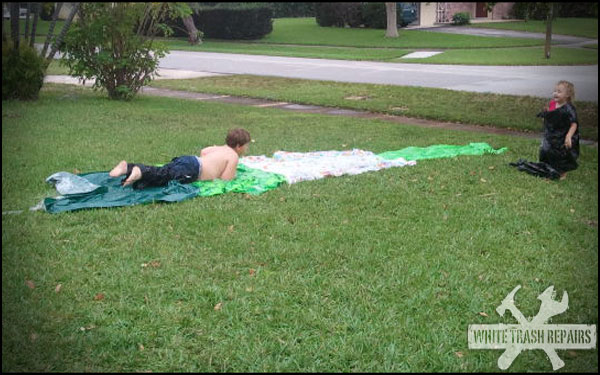
The crack of the bat. The roar of the crowd. The scent of popcorn and sunscreen. These are the hallmarks of a classic baseball game—until, that is, the tarp takes center stage in a spectacle of sheer, unadulterated chaos. Not the kind of chaos that comes from a seventh-inning stretch singalong or a bench-clearing brawl, but the kind that arrives unannounced, slick with rain, and transforms a pristine infield into a deathtrap disguised as a children’s playground. Welcome to the Wet Tarp Slip and Slide: a moment where physics, hubris, and human folly collide in a symphony of slipping, sliding, and spectacularly timed pratfalls.
The Tarp: Baseball’s Most Deceptive Stage Prop
At first glance, the tarp is a humble guardian, a waterproof sentinel draped over the diamond to shield it from the elements. It’s the unsung hero of rain delays, the silent partner in every groundskeeper’s dance with the weather. But beneath its unassuming exterior lies a treacherous paradox: a surface designed for protection, repurposed as a gladiatorial arena. The moment rain turns it into a mirror-smooth sheet of ice, the tarp sheds its utilitarian skin and becomes something far more sinister—a slip-and-slide for the terminally reckless.
Consider the material science at play. Polyethylene, the stuff of grocery bags and cheap raincoats, is stretched taut over the infield, its fibers contracting under tension. Add water, and it becomes a hydrophobic beast, repelling moisture in a way that turns every drop into a potential projectile. The result? A surface that defies traction, where the difference between a sure-footed stride and a humiliating sprawl is measured in millimeters. It’s not just wet—it’s a betrayal.
The Psychology of the Slip: Why We Can’t Look Away
There’s a primal fascination with watching someone lose their footing. It’s the same morbid draw as a car crash on the highway or a banana peel gag in a silent film. The Wet Tarp Slip and Slide taps into this collective voyeurism, offering a front-row seat to the undignified collapse of an adult human. But why does it resonate so deeply? Perhaps it’s the illusion of control. We see a player—often a seasoned professional—approach the tarp with the confidence of a man who’s spent a lifetime mastering his craft. Then, in an instant, that confidence evaporates, replaced by the flailing limbs of a newborn giraffe on roller skates.
There’s also the element of surprise. Baseball players are trained to anticipate the unpredictable—the curveball, the line drive, the umpire’s call. But the tarp? It’s a wildcard, a rogue wave in an otherwise predictable ocean. The moment it betrays them, it’s not just a slip—it’s a psychological gut-punch, a reminder that even the most meticulously honed skills have their limits. And we, the spectators, are complicit in the schadenfreude, laughing not because we’re cruel, but because we recognize the fragility in all of us.
The Anatomy of a Tarp Incident: A Choreography of Calamity
Every Wet Tarp Slip and Slide follows a familiar script, a macabre ballet of missteps and miscalculations. Act One: The Approach. A player, perhaps a coach or an umpire, strides toward the tarp with the swagger of someone who’s never known defeat. Act Two: The First Misstep. A heel catches the edge, or a toe skids on a hidden puddle. The body lurches forward, arms windmilling like a windmill in a hurricane. Act Three: The Descent. Gravity, that merciless choreographer, takes over. The player crumples in stages—first the knees, then the torso, finally the face, as if bowing to the inevitable.
What makes these incidents so mesmerizing is their unpredictability. No two slips are alike. Some players go down like a felled oak, limbs splayed in a starfish formation. Others crumple like a marionette with cut strings, their dignity dissolving in real time. The most unlucky souls manage to take out a teammate on the way down, turning a solo pratfall into a full-blown slapstick ensemble piece. It’s a reminder that even in the most controlled environments, chaos is always lurking, waiting for its moment to strike.
The Aftermath: From Laughter to Lingering Doubt
The immediate reaction is, of course, laughter. The crowd erupts, a wave of collective amusement washing over the stadium. Players on the field double over, hands on knees, gasping for air between guffaws. Social media explodes with memes and GIFs, immortalizing the moment in digital amber. But beneath the mirth lies a darker undercurrent—a nagging question: What if it had been worse? What if the player had landed on their head, or twisted an ankle so severely that their season was over? The Wet Tarp Slip and Slide is a microcosm of risk in baseball, a reminder that even the most mundane tasks can become perilous in the wrong conditions.
For the player involved, the aftermath is a cocktail of embarrassment and relief. There’s the immediate sting of humiliation, the kind that lingers long after the game has ended. But there’s also the knowledge that they dodged a bullet—literally. A broken bone or a concussion would have turned the joke into a tragedy, and suddenly, the laughter feels a little less carefree. It’s a humbling experience, one that strips away the veneer of invincibility that athletes often project.
The Tarp as Metaphor: Life’s Slippery Slopes
The Wet Tarp Slip and Slide is more than just a viral moment—it’s a metaphor for life itself. How many times have we approached a task with confidence, only to find ourselves flat on our backs, wondering what went wrong? The tarp is life’s uncooperative floor, the universe’s way of reminding us that control is an illusion. It’s a lesson in humility, delivered with the force of a 250-pound man hitting the ground at full speed.
In baseball, as in life, the difference between success and failure often comes down to preparation. Players spend hours in the batting cage, on the field, in the weight room, honing their craft. But no amount of training can account for a surface that betrays them. The tarp is a great equalizer, a leveller of egos and a humbler of heroes. It doesn’t care about your batting average or your ERA. It doesn’t care about your contract or your endorsement deals. All it cares about is physics—and your ability to stay upright.
The Legacy of the Wet Tarp: A Moment Etched in Infamy
Some moments in sports are so absurd, so perfectly timed, that they transcend the game itself. The Wet Tarp Slip and Slide is one of those moments. It’s a snapshot of human fallibility, a fleeting glimpse into the chaos that lurks beneath the surface of even the most controlled environments. It’s a reminder that life, like baseball, is unpredictable—and that sometimes, the most memorable plays are the ones we never saw coming.
For years to come, fans will rewatch the footage, pointing and laughing, marveling at the sheer audacity of gravity’s triumph. Players will shudder at the memory, vowing never to underestimate the tarp again. And groundskeepers? They’ll keep their tarps taut, their edges secure, knowing that the line between order and chaos is thinner than they’d like to admit. The Wet Tarp Slip and Slide isn’t just a moment—it’s a legend, a cautionary tale, and perhaps, in its own way, a work of art.