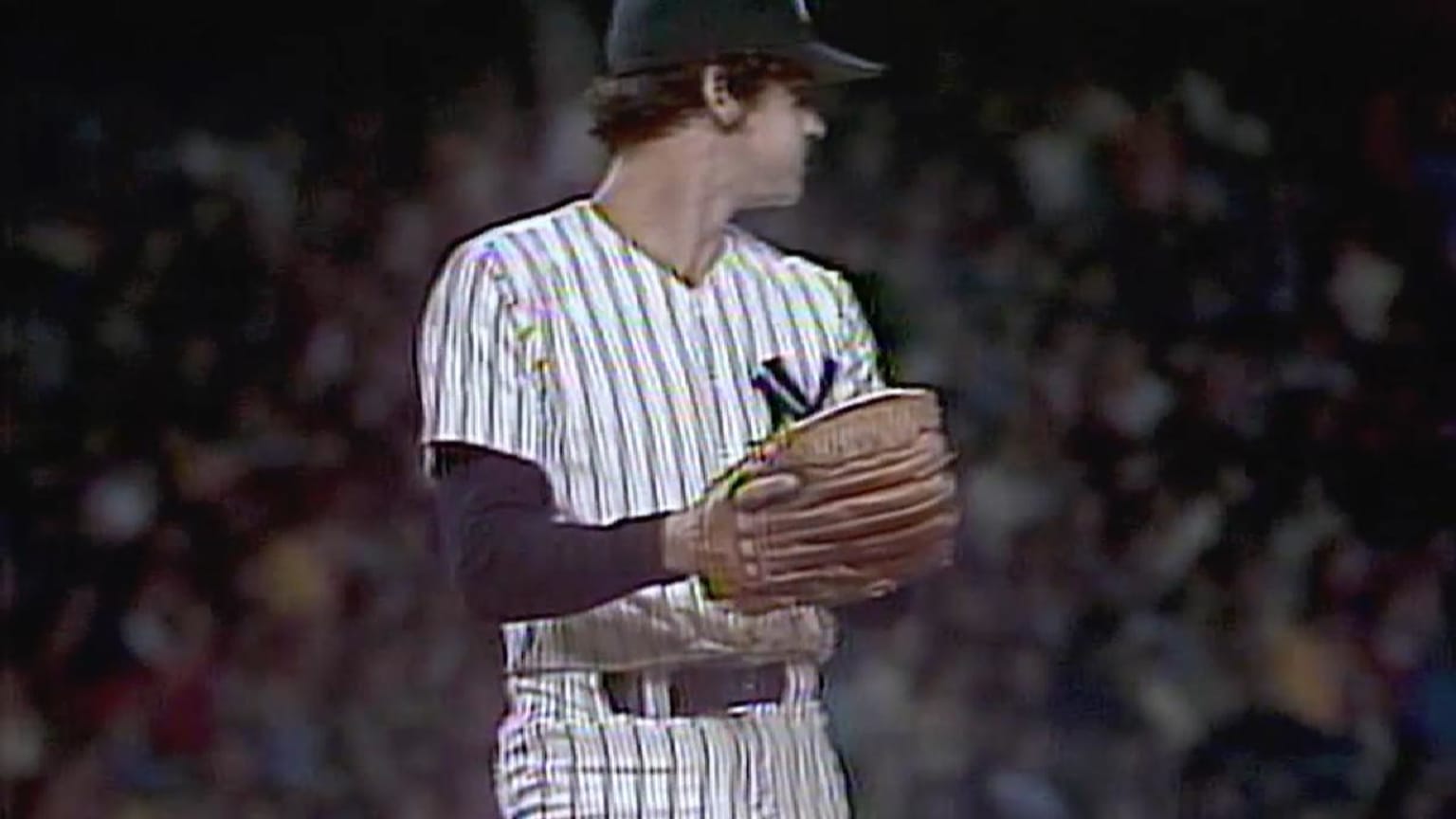
The name Ron Guidry still resonates like a vintage vinyl spinning on a turntable, its grooves etched with the crackle of glory and the hum of a bygone era. Once the left-handed maestro of the New York Yankees’ pitching mound, Guidry didn’t just throw baseballs—he hurled thunderbolts wrapped in pinstripes, leaving batters dazed and fans breathless. But where does a legend like Guidry dwell now, beyond the roar of the stadium and the flash of highlight reels? His journey has shifted from the diamond’s diamond dust to quieter corners of life, where time moves in measured steps and memories are polished like old trophies. This is the untold story of where Ron Guidry is now—a tale woven from nostalgia, quiet dignity, and the enduring spirit of a man who once made baseball history.
The Pitcher Who Stole the Show: A Brief Resurgence of Memory
To understand where Ron Guidry is today, one must first revisit the spectacle he once embodied. In the late 1970s and early 1980s, Guidry wasn’t just a player; he was a phenomenon. Nicknamed “Louisiana Lightning,” he struck fear into the hearts of opposing hitters with a fastball that seemed to defy physics and a slider that danced like a firefly in the night. His 1978 season—a symphony of dominance—saw him post a 25-3 record, a 1.74 ERA, and a Cy Young Award, all while anchoring a Yankees team that captured the World Series. Guidry’s left arm became a metronome, ticking off strikeouts with mechanical precision, each pitch a brushstroke on the canvas of baseball immortality. Yet, like all great artists, his peak was fleeting, a comet blazing across the sky before retreating into the cosmic dark. But the brilliance of his performance lingers, a spectral echo in the annals of the sport.
The Transition from Thunder to Twilight
Retirement, for athletes of Guidry’s caliber, is rarely a clean break. It’s more like a slow fade to black, where the spotlight dims but the stage remains. After hanging up his cleats in 1988, Guidry didn’t vanish into obscurity. Instead, he stepped into a new role—one less about velocity and more about legacy. He remained tethered to the Yankees organization, serving as a pitching coach and later as a special advisor, his voice a steadying presence in the clubhouse. Guidry’s transition mirrored the lifecycle of a great oak: roots deep in the soil of the game, branches stretching toward the future, but the trunk forever marked by the rings of its storied past. He became a bridge between eras, a living link to the Yankees’ golden age, his wisdom passed down like a sacred text to younger pitchers who never saw him pitch but felt his influence nonetheless.
The Quiet Life Beyond the Diamond’s Glare
While Guidry’s professional life kept him connected to baseball, his personal life has unfolded in the hushed corridors of everyday existence. Unlike the flashy retirements of some athletes—endorsement deals, reality TV cameos, or entrepreneurial gambles—Guidry’s post-playing years have been marked by understated elegance. He retreated to his home state of Louisiana, where the bayous whisper secrets and the air carries the scent of magnolias. There, he embraced a life far removed from the cacophony of New York’s media circus. Fishing, golf, and spending time with family became his new routines, each activity a gentle counterpoint to the adrenaline-fueled chaos of his playing days. It’s a life of quiet reflection, where the only applause comes from the rustle of leaves or the distant call of a loon. In this setting, Guidry’s legend doesn’t need amplification; it simply is.
The Unseen Hand: Guidry’s Influence in Modern Baseball
Even in retirement, Guidry’s impact on baseball endures, though it often operates like a subterranean river—powerful yet unseen. His pitching mechanics, once dissected by analysts and mimicked by aspiring hurlers, remain a blueprint for efficiency and control. Modern pitchers, from Gerrit Cole to Blake Snell, have cited Guidry’s approach as an inspiration, proof that artistry in pitching transcends eras. Guidry’s legacy also lives on in the Yankees’ pitching philosophy, where a blend of discipline and creativity is prized above raw velocity. He embodies the ideal of the craftsman, a man who mastered his craft not through brute force but through precision and intuition. In an age where analytics dominate the conversation, Guidry’s career stands as a testament to the timeless allure of feel and instinct.
The Man Behind the Myth: Personality and Presence
To know Ron Guidry is to understand that his greatness extended beyond statistics and highlights. Those who’ve met him often describe a man of quiet charisma, someone who carried himself with the unassuming grace of a small-town banker rather than a sports icon. His demeanor was a study in contrasts: fiercely competitive on the mound, yet warm and approachable off it. Teammates recall his dry wit and steady presence, a calming influence in the high-pressure crucible of a pennant race. Guidry’s humility was his superpower, a trait that made him beloved by fans and respected by peers. He never sought the spotlight for its own sake; he let his performance speak for him. In an era where athletes often cultivate larger-than-life personas, Guidry’s authenticity was his most enduring appeal.
The Legacy in Perpetuity: How History Remembers Guidry
History has a way of sifting the fleeting from the eternal, and Ron Guidry’s place in baseball’s pantheon is secure. He is remembered not just for his statistics—though they are staggering—but for the way he played the game. Guidry embodied the spirit of the Yankees’ dynasty of the late 1970s, a team that blended power, precision, and personality into an unstoppable force. His 1978 season, in particular, is enshrined in the collective memory of baseball fans, a masterclass in dominance. Yet, his legacy is also one of longevity and loyalty. Unlike many stars who burn bright and fade fast, Guidry’s career spanned a decade and a half, a testament to his durability and adaptability. He was the kind of player who made the game feel timeless, a reminder that greatness isn’t measured in moments but in the indelible mark left on the sport itself.
The Future: What Lies Ahead for a Living Legend
As the years advance, Ron Guidry’s role in the baseball world may evolve further, but his place in history is immutable. He is now a custodian of the game’s heritage, a figure who bridges the gap between the Yankees’ past and its future. Whether he remains involved in the sport through mentorship, charitable work, or simply as a revered elder statesman, his influence will persist. For younger generations, Guidry represents the golden age of baseball—a time when the game was as much about artistry as it was about athleticism. His story is a reminder that legends don’t retire; they simply find new ways to inspire. And so, the question of “Where is Ron Guidry now?” is answered not with a location, but with a legacy—one that continues to resonate, like the final chord of a symphony that never truly ends.