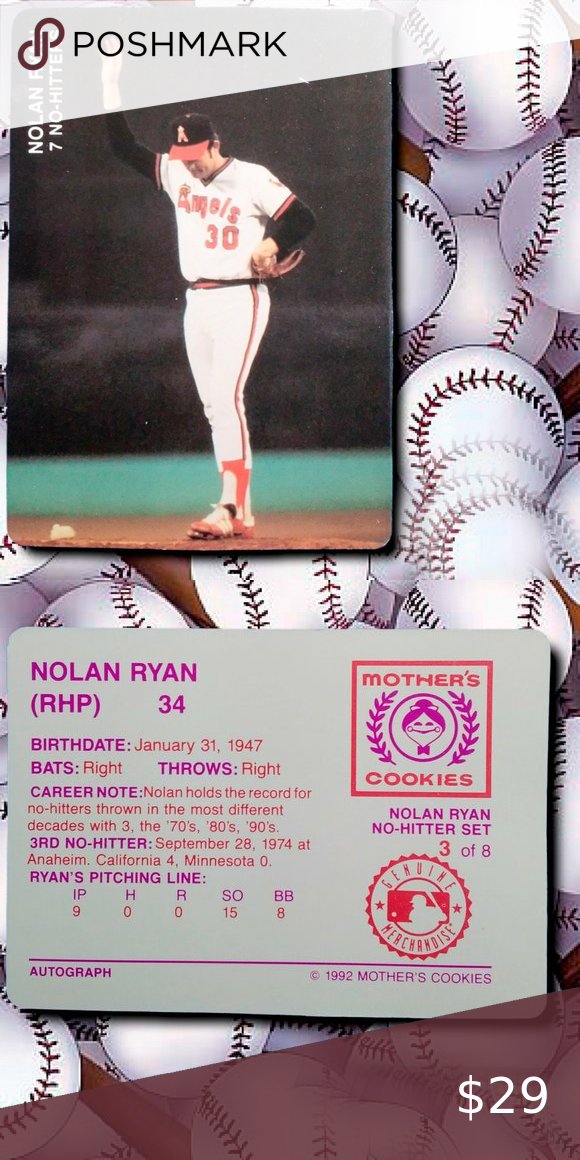
In the pantheon of baseball legends, few names resonate with the same mythic grandeur as Nolan Ryan. Not merely a pitcher, but a force of nature who defied the very limits of human endurance and statistical possibility, Ryan didn’t just play the game—he redefined its boundaries. His career, spanning an astonishing 27 seasons across four decades, was punctuated by moments so improbable they bordered on the supernatural. Yet it was not his longevity alone that etched his name into history, but the seven no-hitters he hurled upon unsuspecting lineups—a record that remains untouched, a testament to a pitching prowess that transcended eras. To understand Nolan Ryan’s seven no-hitters is to peer into the heart of baseball’s most elusive and electrifying phenomenon: the perfect storm of velocity, precision, and psychological dominance.
The Genesis of a Legend: How a Small-Town Texan Became a Pitching Titan
Nolan Ryan was born not in the neon glow of a major league stadium, but in the quiet expanse of rural Texas, where the horizon stretched farther than the ambitions of most young athletes. Raised on hard work and humility, he honed his craft not in the polished academies of the East, but on the dusty diamonds of Alvin High School. His fastball, already a blur to opposing batters, caught the eye of scouts who saw something otherworldly in its searing velocity. By the time he debuted in the major leagues at 19, Ryan wasn’t just another rookie—he was a harbinger of change, a pitcher whose arm seemed capable of bending the laws of physics. His early years were marked by inconsistency, a common affliction for young flamethrowers who relied too heavily on raw power. But beneath the radar, Ryan was refining a weapon that would soon become his signature: the fastball that didn’t just beat batters, but intimidated them into submission.
The Anatomy of a No-Hitter: More Than Just a Streak of Zeros
A no-hitter is not merely a game without hits—it is a psychological siege, a battle of wills where the pitcher’s dominance is absolute and the batter’s hope is systematically dismantled. For Ryan, each no-hitter was a masterclass in psychological warfare. His fastball, clocked at speeds that defied the era’s radar guns, wasn’t just fast—it was *unfathomable*. Batters described it as a blur, a white comet streaking toward them at velocities that made the bat feel like a toothpick. But Ryan’s genius lay not in speed alone. He wielded a repertoire of pitches with the precision of a surgeon, his curveball a slow, deceptive spiral that lured swings into the stratosphere, his changeup a sudden drop that left batters lunging at thin air. To face Nolan Ryan was to be outmatched before the first pitch was thrown—a feeling that only deepened with each no-hitter he authored.
The First Strike: Ryan’s Maiden No-Hitter and the Birth of a Myth
On May 15, 1973, in a game against the Kansas City Royals, Nolan Ryan etched his name into the record books for the first time. The box score tells a story of perfection: 12 strikeouts, no hits, no walks. But the narrative is richer than statistics. The Royals, a team built on contact hitting, were ill-equipped to handle Ryan’s arsenal. His fastball, already a legend in the making, was paired with a slider that cut through the strike zone like a scalpel. By the seventh inning, the crowd at Anaheim Stadium was silent, the air thick with the weight of witnessing something historic. When the final out was recorded—a ground ball back to the mound—Ryan didn’t celebrate with the exuberance of a young pitcher. Instead, he stood stoic, as if he’d known all along that this was merely the first chapter of a far grander story.
The Unbreakable Record: Why Seven No-Hitters Defy the Laws of Probability
In an era where specialization and pitch counts govern the modern game, Ryan’s seven no-hitters seem like relics from a bygone age—when pitchers were expected to throw complete games, when fatigue was a badge of honor, and when the idea of a no-hitter wasn’t just a possibility, but a recurring reality. To put this into perspective, consider that the next closest pitcher, Sandy Koufax, threw four. The gap between them isn’t just statistical; it’s existential. Ryan’s no-hitters weren’t flukes or one-off performances. They were the product of a relentless work ethic, a body that seemed impervious to the wear of time, and a mindset that thrived under pressure. Each no-hitter was a reminder that baseball, at its core, is a game of inches—and Ryan had the rare ability to shrink those inches to the size of a needle’s eye.
The Human Element: The Stories Behind the No-Hitters
Behind every no-hitter lies a story, a moment frozen in time that transcends the box score. Ryan’s second no-hitter, thrown in 1974 against the Baltimore Orioles, was a masterclass in adaptation. The Orioles, a team built on discipline and contact, were undone by Ryan’s ability to elevate his fastball just enough to catch the top of the zone, then bury it just enough to induce weak grounders. His third, in 1975, came against the Detroit Tigers, a team that featured future Hall of Famers like Al Kaline and Willie Horton. Yet Ryan struck out 16, a display of dominance so complete that it felt like a private lesson in humility for the entire league. And then there was his sixth no-hitter, thrown in 1990 at the age of 43, a feat that defied not just the odds, but the very notion of aging in sports. In each instance, Ryan wasn’t just pitching—he was storytelling, weaving a narrative of dominance that left fans and opponents alike in awe.
The Legacy of a No-Hitter: How Ryan Redefined Pitching Greatness
Nolan Ryan’s seven no-hitters are more than a collection of statistical anomalies—they are a blueprint for pitching greatness. They forced the game to evolve, to adapt to a pitcher who didn’t just challenge hitters, but redefined the very concept of possibility. His no-hitters weren’t just games; they were cultural touchstones, moments that transcended baseball and entered the realm of legend. They inspired a generation of pitchers to throw harder, to refine their craft, and to embrace the idea that greatness wasn’t just about skill, but about the will to dominate. Today, as analytics and pitch tracking dominate the conversation, Ryan’s no-hitters serve as a reminder of a time when baseball was less about data and more about artistry—a time when a pitcher could stand on the mound and, for a few fleeting moments, become something akin to a myth.
The Myth Lives On: Why Ryan’s No-Hitters Still Captivate the Imagination
Decades after his final pitch, Nolan Ryan’s no-hitters endure as some of the most indelible moments in baseball history. They are studied, revered, and mythologized, not just for their rarity, but for the aura of invincibility they carried. In an age where no-hitters are celebrated as once-in-a-generation events, Ryan’s seven stand as a reminder that true greatness isn’t measured in trophies or accolades, but in the ability to defy expectation. His no-hitters were never just about the zeros in the hit column—they were about the way he made the game feel smaller, the way he turned the mound into a throne from which he ruled over batters with an iron fist. To this day, when a pitcher toes the rubber with the weight of history on his shoulders, it’s Nolan Ryan’s ghost that lingers in the air, a whisper that says: *This is what it means to be unstoppable.*