What if a single pitch could rewrite the script of a baseball game before the batter even steps into the batter’s box? Not with a 105-mph fastball that vanishes into the catcher’s mitt, nor with a curveball that dives like a seabird into the dirt—but with a pitch so subtle, so deceptive, that its true impact isn’t measured in velocity or spin rate, but in the quiet calculus of runs saved and opportunities denied. This is the realm of the “run value” of a pitch—a metric that doesn’t just quantify performance, but redefines what it means to dominate an at-bat. And when that pitch is the splinker, wielded by a rookie sensation like Paul Skenes, the numbers don’t just tell a story; they whisper a revolution.
The Splinker: A Pitch Born from Chaos and Precision
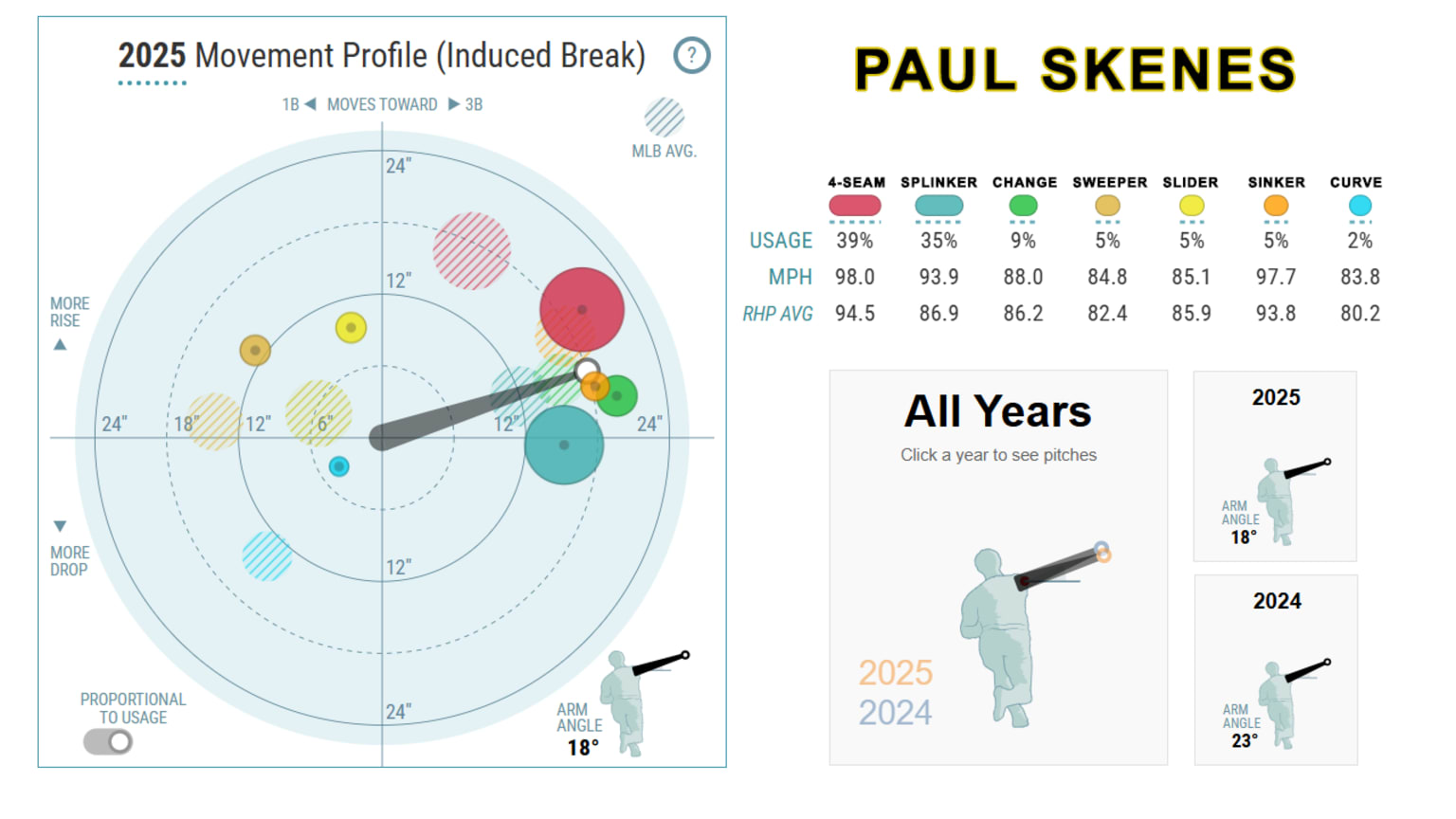
The splinker isn’t a pitch you’ll find in any official MLB glossary. It’s a Frankenstein creation, a monstrous hybrid of a splitter’s late dive and a sinker’s tailing action, born from the mind of a pitcher who refuses to be pigeonholed. Skenes’ version is a 95-mph missile that doesn’t just challenge the hitter’s timing—it dismantles it. The splinker’s genius lies in its duality: it arrives with the velocity of a fastball but behaves like a breaking ball, its downward movement so pronounced that even the most disciplined hitters are left lunging at thin air. But velocity alone doesn’t tell the full story. The real magic happens in the spin axis and seam orientation, where the pitch’s gyroscopic stability turns it into a guided missile, one that refuses to be squared up.
What makes the splinker particularly insidious is its ability to masquerade as something it’s not. To the hitter, it looks like a fastball early in the zone, only to betray its true nature with a late, downward plunge that turns a potential line drive into a harmless grounder. The splinker doesn’t just induce weak contact—it manufactures it. And in a sport where a single run can swing a game, the value of a pitch that systematically suppresses offensive production isn’t just high; it’s stratospheric.
Run Value: The Silent Currency of Pitching Dominance
Run value is the lingua franca of modern pitching analytics, a single number that distills the chaos of a baseball game into a tidy, quantifiable metric. But what does it really measure? At its core, run value answers a deceptively simple question: How many runs does this pitch prevent compared to a league-average offering? It’s not just about strikeouts or home runs allowed—it’s about the cumulative effect of every pitch on the scoreboard. A pitcher who induces weak contact with a splitter might not rack up strikeouts, but if those ground balls consistently strand runners or turn double plays, the run value soars.
For Skenes’ splinker, the run value is staggering. Consider this: In a league where the average fastball yields a .350 batting average on balls in play (BABIP), the splinker’s BABIP hovers around .220. That’s not just a difference—it’s a chasm. Over the course of a season, a pitch that suppresses BABIP by 130 points doesn’t just save runs; it redefines the pitcher’s role from mere participant to architect of defensive efficiency. The splinker doesn’t just get outs—it manufactures outs that might not have existed otherwise.
But run value isn’t static. It’s a living, breathing entity that shifts with every pitch, every batter, every count. A 0-2 count with the splinker is a nuclear option, a pitch that turns an already disadvantaged hitter into a spectator. The run value in those situations isn’t just high—it’s off the charts. And when a pitcher can consistently leverage those counts, the cumulative effect on a team’s run prevention is nothing short of transformative.
The Psychological Chess Match: How the Splinker Disrupts Hitters
Baseball is as much a mental game as it is a physical one, and the splinker exploits this duality with surgical precision. Hitters don’t just face a pitcher’s arm—they face a labyrinth of probabilities, a game of predictive roulette where one wrong guess can mean the difference between a line drive and a broken bat. The splinker weaponizes this uncertainty. By blending seamlessly into a pitcher’s fastball-heavy repertoire, it forces hitters to second-guess their instincts. Do they sit on a fastball? The splinker will punish them with a late dive. Do they cheat on a breaking ball? The splinker’s velocity will catch them off guard.
This psychological warfare extends beyond individual at-bats. When a pitcher like Skenes deploys the splinker in high-leverage situations, it doesn’t just change the outcome of the pitch—it alters the entire strategic landscape. Hitters begin to overthink. They expand their zones. They chase pitches they wouldn’t normally consider. And in doing so, they hand the pitcher an even greater advantage. The splinker isn’t just a pitch; it’s a psychological disruptor, a tool that turns the batter’s box into a pressure cooker of doubt.
But here’s the catch: The splinker’s effectiveness isn’t infinite. Hitters are adaptable. They study. They adjust. The challenge for pitchers who rely on such a pitch is maintaining its efficacy over time. Can Skenes refine the splinker’s movement to stay one step ahead of the league’s best hitters? Or will the splinker’s mystique fade as the league’s analytics departments dissect its secrets? The run value of the splinker today might not be the run value of the splinker tomorrow—and that’s the beauty of baseball’s eternal cat-and-mouse game.
Beyond the Splinker: The Future of Pitch Design and Run Prevention
The splinker is more than a pitch; it’s a harbinger of the future. As pitchers like Skenes push the boundaries of pitch design, the metrics that define dominance are evolving. Run value is no longer just about strikeouts or walks—it’s about the subtle art of manufacturing outs through deception, movement, and precision. The next frontier in pitching isn’t just velocity; it’s the ability to make hitters look foolish without ever throwing a pitch that resembles a traditional breaking ball.
This evolution presents a tantalizing challenge for the sport. If the splinker becomes the blueprint for run prevention, how will hitters respond? Will we see a surge in “splinker specialists”—pitchers whose arsenals revolve around a single, devastating pitch? Or will the league adapt, developing new training techniques to neutralize such offerings? The run value of the splinker might be high today, but the arms race of baseball ensures that no advantage is permanent.
For now, though, the splinker reigns supreme. It’s a pitch that doesn’t just get outs—it redefines what an out looks like. And in a sport where runs are the currency of victory, the ability to suppress them with surgical precision is the ultimate power. The question isn’t whether the splinker will change baseball—it’s how quickly the rest of the league will catch up.