In the grand mosaic of baseball card collecting, where the luminaries of the diamond often command the spotlight, there exists a hidden gem—a card that whispers of untold potential rather than shouts of legendary feats. The Eric Davis rookie card is one such treasure, a relic that captures the fleeting brilliance of a player whose career flickered like a shooting star across the night sky of the 1980s and 1990s. To the uninitiated, it may seem like just another piece of cardboard, but to the discerning collector, it is a portal to a bygone era of raw athleticism, unfulfilled promise, and the bittersweet allure of “what if?”
The Eric Davis rookie card is not merely a collectible; it is a time capsule, a frozen moment where the kinetic energy of a young athlete’s swing is preserved in glossy perfection. Imagine, if you will, a baseball card as a palimpsest—a manuscript where the original text has been scraped away to make room for new writing, yet the faintest traces of the past linger beneath the surface. Davis’s rookie card is such a palimpsest, bearing the ghostly imprints of his potential, his injuries, and the relentless pace of a career that burned too bright, too soon. It is a card that invites collectors to peer into the negative space of his story, to fill in the blanks with their own interpretations of greatness deferred.
The Allure of the Underdog: Why Davis’s Rookie Card Resonates
Baseball, at its core, is a sport of contrasts—glory and failure, triumph and tragedy, the sublime and the mundane. Eric Davis embodied these contrasts in ways that make his rookie card a magnet for collectors who crave more than just the sheen of stardom. Unlike the cardboard immortals whose careers unfolded like a well-scripted epic, Davis’s journey was a tragicomedy, a narrative where the hero’s arc was constantly interrupted by the cruel hand of fate. His rookie card, therefore, is not just a piece of memorabilia; it is a memento mori, a reminder of the fragility of athletic greatness.
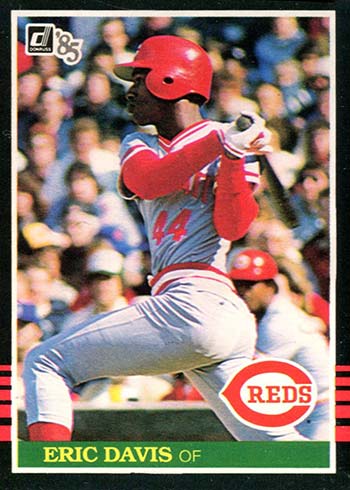
Consider the visual language of Davis’s 1985 Donruss rookie card. The photograph captures him mid-swing, his body coiled like a spring, his eyes locked onto an invisible ball with the intensity of a man who knows he is playing for something greater than himself. The background is a blur of colors, a kaleidoscope of stadium lights and adoring fans, yet Davis stands apart, a singular figure in a universe of motion. This is no mere trading card; it is a stroboscopic snapshot, a single frame that encapsulates the entire drama of his career—the raw power, the lightning speed, the promise of a player who could have been the next Willie Mays, if only the baseball gods had been kinder.
Collectors are drawn to Davis’s rookie card for the same reason they are drawn to the underdog in any story: it is a testament to resilience. Davis overcame a childhood in poverty, the loss of his father, and a series of injuries that would have broken lesser men. His rookie card is a tangible link to that resilience, a physical artifact that whispers of a player who refused to be defined by his limitations. In a hobby often dominated by the pristine and the perfect, Davis’s card is a breath of fresh air—a reminder that greatness is not always measured in statistics or championships, but in the sheer force of will it takes to rise, again and again, from the ashes of adversity.
The Aesthetic Alchemy: Design and Condition as Collecting Holy Grails
The allure of the Eric Davis rookie card is not solely rooted in its subject matter; it is also a product of its aesthetic alchemy—the way its design, condition, and scarcity combine to create a collectible that is as much art as it is investment. The 1985 Donruss set, of which Davis’s card is a cornerstone, is a masterclass in early 1980s sports card design. The borders are bold, the colors are vibrant, and the photography is crisp, capturing the dynamism of the players in a way that feels almost cinematic. Davis’s card, in particular, benefits from this aesthetic, its composition drawing the eye to the subject with the precision of a well-executed double play.
Yet, it is in the patina of the card—its wear, its imperfections, the way time has etched its story into the cardboard—that its true magic lies. A Davis rookie card in pristine condition, with sharp corners and vibrant colors, is a sight to behold, a pristine relic of a bygone era. But it is the card with the character marks—the slight crease here, the faint corner ding there—that often tells the most compelling story. These imperfections are not flaws; they are battle scars, evidence of a card that has been loved, handled, and cherished over the decades. They are the physical manifestation of the collector’s journey, a tangible connection to the past that cannot be replicated by a mint-condition gem.
Condition, in the world of Davis rookie cards, is a spectrum rather than a binary. A PSA 9 may be the holy grail for some, but it is the PSA 6 or 7 that often captures the imagination. These cards, with their visible signs of age and use, evoke a sense of nostalgia, a link to the days when baseball cards were not just investments but daily companions—tucked into pockets, swapped with friends, and pored over with the fervor of a fanatic. The Eric Davis rookie card, in this light, is not just a collectible; it is a relic of childhood, a piece of Americana that transcends its monetary value to become a vessel for memory.
The Davis Effect: How His Legacy Elevates the Card’s Status
Eric Davis’s career was a study in contrasts, a symphony of brilliance and heartbreak that has left an indelible mark on the baseball world. His rookie card, therefore, is not just a reflection of his potential; it is a cultural artifact, a piece of history that encapsulates the spirit of an era. To understand the Davis rookie card is to understand the 1980s—a decade of excess, of neon lights and shoulder pads, of a sport that was as much about style as it was about skill. Davis, with his lightning speed and prodigious power, was the embodiment of this era, a player who made the game look effortless, even as the weight of expectation bore down on him.
His rookie card is a gateway to this world, a portal to a time when baseball cards were as much about the artistry of the design as they were about the players themselves. The 1985 Donruss set, with its bold colors and dynamic photography, was a departure from the staid, traditional designs of the past. It was a set that embraced the hyperrealism of the era, a visual language that mirrored the larger-than-life personalities of the players. Davis, with his charismatic grin and electrifying playstyle, was the perfect subject for this aesthetic. His rookie card, therefore, is not just a collectible; it is a cultural timepiece, a snapshot of a moment when baseball and pop culture collided in spectacular fashion.
Moreover, Davis’s career arc adds a layer of complexity to his rookie card that few others can match. His 40-40 season in 1987—a feat achieved by only a handful of players in history—cemented his legacy as one of the game’s most electrifying talents. Yet, his career was also marked by injuries, by the cruel irony of a body that could not keep pace with his ambition. This duality is what makes his rookie card so compelling. It is a card that does not just celebrate what was; it mourns what could have been. It is a card that invites collectors to imagine the alternate realities where Davis’s career reached its full potential, where the “what ifs” of his story played out in a different, more triumphant script.
The Market’s Whisper: Why Collectors Seek Out Davis’s Card
In the vast and often impersonal world of sports card collecting, the Eric Davis rookie card stands out as a quiet contender, a card whose value is not solely determined by its scarcity or its condition, but by the intangible qualities that make it a collector’s dream. Unlike the cardboard titans of the hobby—Mantle, Mantle, and Mantle again—Davis’s card does not command stratospheric prices. It is not a status symbol, a trophy to be displayed in a climate-controlled case. Instead, it is a hidden gem, a card that is sought after by those in the know, by collectors who understand its unique appeal.
The market for Davis rookie cards is a study in subtle demand. Prices fluctuate not with the whims of the masses, but with the discerning tastes of a niche audience. A high-grade Davis rookie card may sell for a few hundred dollars, while a lower-grade example can be had for a fraction of that. Yet, for the right collector, the card is priceless. It is a card that does not just sit in a collection; it converses with it, sparking memories of childhood, of games watched on a grainy television, of the thrill of opening a pack and seeing a hero’s face for the first time.
This quiet demand is what makes the Davis rookie card so special. It is a card that rewards patience, that thrives in the shadows of the hobby’s more prominent figures. It is a card that speaks to the collector’s soul, to the part of them that remembers the joy of the game before it became an industry. In a world where sports cards are often treated as commodities, the Eric Davis rookie card is a reminder of what the hobby was, and what it can still be—a celebration of the game, the players, and the collectors who keep the flame alive.
The Eric Davis rookie card is more than just a piece of cardboard; it is a love letter to the game of baseball, a testament to the beauty of what could have been, and a tangible link to a player whose legacy is as complex as it is captivating. To hold one in your hands is to hold a piece of history, a fragment of a story that is still being written. It is a card that does not just tell the tale of Eric Davis; it invites you to become a part of it, to add your own chapter to the narrative of greatness deferred. In a hobby often dominated by the loud and the proud, the Davis rookie card is a whisper—a gentle reminder that the most compelling stories are not always the ones that end in triumph, but the ones that linger in the realm of possibility, forever just out of reach.