Imagine a baseball hurtling through the air towards second base, a silent messenger of the unfolding game’s tension and precision. This moment, fraught with anticipation and motion, embodies a fascinating interplay of energy forms. Understanding whether the baseball’s motion represents kinetic or potential energy opens a window into the fundamental principles governing not just sports, but the very essence of physical interactions. Let’s venture into this dynamic world and unravel the mystery with clarity and nuance.
Defining Energy in Motion: Kinetic and Potential Energy
Energy, the invisible currency of activity in the universe, manifests itself in diverse forms. Two of the most commonly encountered types in everyday life are kinetic and potential energy. Kinetic energy is the energy of motion. It is what you observe when an object moves — a baseball speeding towards second base carries kinetic energy, a testament to its mass and velocity. This energy is quantifiable by the formula KE = ½ mv², where m is mass and v is velocity.
On the other hand, potential energy is the energy stored within an object due to its position, configuration, or state. Think of a coiled spring or a raised weight on a shelf, ready to unleash motion but currently stationary — this stored capacity is potential energy. It’s the dormant promise of motion waiting to be released, often represented as PE = mgh, where m is mass, g is gravitational acceleration, and h is height.
The Baseball at Rest: A Reservoir of Potential Energy
Before the ball is thrown, it exists in a state brimming with potential. Cradled in the pitcher’s hand, it holds mechanical potential energy, carefully poised. This energy is latent but palpable, like a drawn bowstring or a pendulum perched at its peak in silent anticipation. The position of the baseball relative to the pitcher’s body and the slight tension in the arm’s muscles together embed the ball with stored energy ready for conversion.
This snapshot of stillness is critical. The baseball, motionless in the pitcher’s grasp, embodies the concept of potential energy. It is unable to initiate the game’s motion until an external force—the pitcher’s throw—converts this potential into the vibrant dance of kinetic energy.
The Throw: The Moment of Energy Transformation
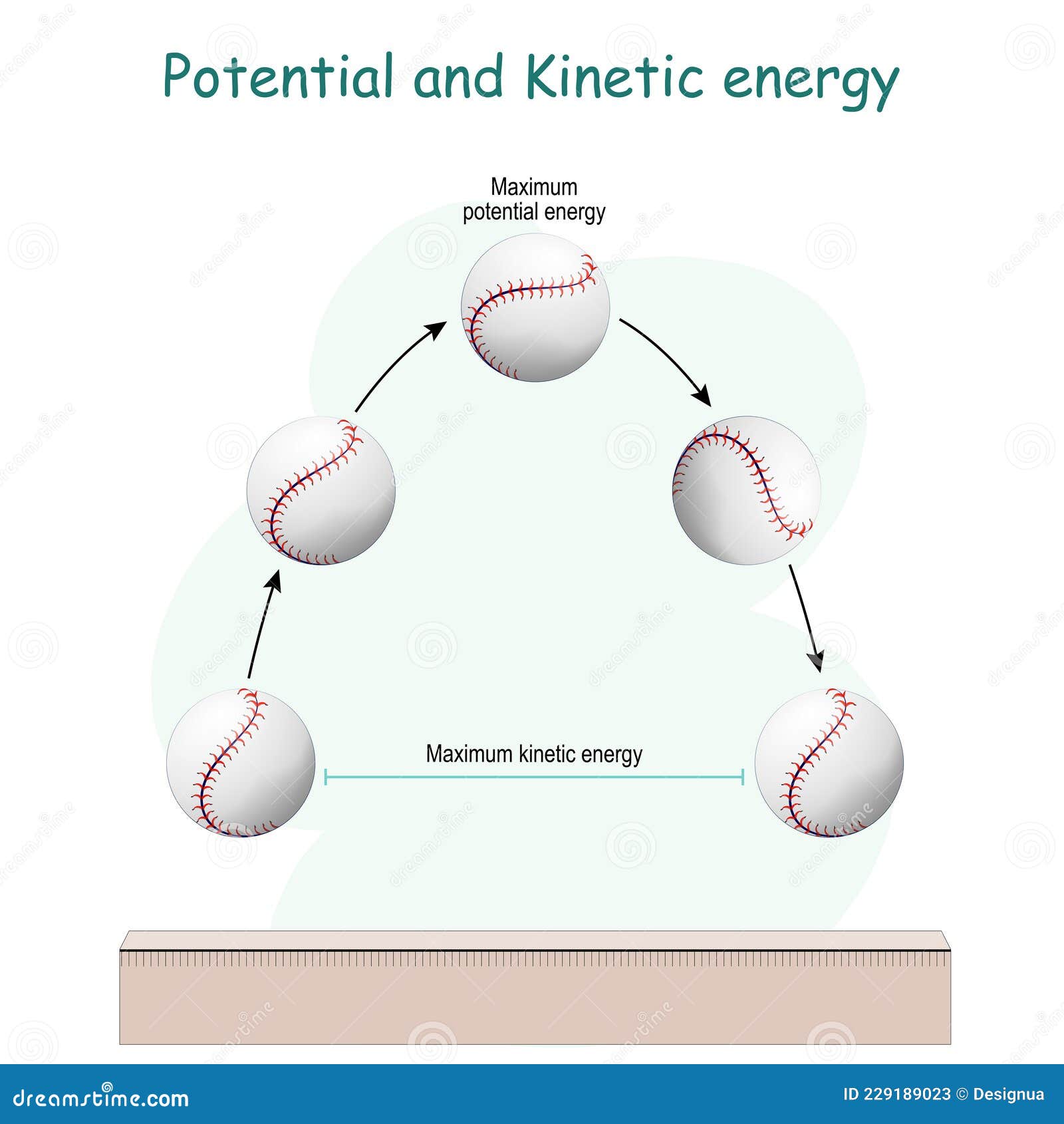
When the pitcher unleashes the ball, a remarkable transformation unfolds. The perfectly orchestrated muscles of the arm impart force, accelerating the ball into motion. This catalytic moment is an elegant transmogrification from potential to kinetic energy. The previously stored energy embodied by the poised ball translates into motion energy, propelling the sphere towards second base.
During this metamorphosis, the baseball surges forward, its energy measured in the velocity and mass that choreograph its flight. The metric of kinetic energy encapsulates this new existence — an energy in action, no longer potential but kinetic. This changeover is dynamic and momentous, reflecting an instantaneous shift from readiness to activity.
Midflight: The Baseball’s Kinetic Dominance
As the baseball arcs through space, kinetic energy reigns supreme. It possesses the energy of movement unambiguously, its speed a gauge of this state. The ball’s potential energy at this point is minimal, possibly relegated to minor gravitational potential variations if the trajectory changes altitude — but these are negligible compared to the dominance of kinetic energy.
The ball’s kinetic energy props up the athletic contest, dictating how it navigates the air resistance and reaches its targeted destination. This phase is a vivid illustration of kinetic energy’s hallmark: tangible, immediate, and intertwined with velocity.
Approaching Second Base: Energy and Its Implications
As the baseball nears second base, kinetic energy continues to characterize its nature. This velocity-centric energy determines not only how quickly the ball arrives but also how effectively it may be caught or deflected. The energy it carries influences every subsequent interaction — the catch, the throw, the tag — weaving into the fabric of the game’s narrative.
Potential energy at this moment remains inconsequential compared to the overwhelming presence of kinetic energy. The ball’s fate is tied to its motion, a kinetic symphony culminating in precise athletic movements.
When Kinetic Energy Reverts: The Catch and Aftermath
Upon being caught or halted at second base, the baseball once again undergoes conversion. Its kinetic energy dissipates or transfers — sometimes converted back into potential energy if held aloft or moved to a new position. This cyclic flow of kinetic and potential energy underpins physical interactions in sports and nature alike.
For example, after the catch, the glove’s position relative to the ground introduces a renewed element of potential energy. Similarly, as the next throw is prepared, energy storage and conversion recommence, sustaining the ebb and flow of the game.
Unpacking the Unique Appeal of Energy in Sports
The energy transformations inherent in a baseball thrown to second base highlight the captivating intersection of physics and sport. This interplay is not just scientific; it embodies the thrill, unpredictability, and beauty that captivates audiences worldwide. Energy’s fluidity — shifting from potential to kinetic and back — serves as metaphor for momentum shifts in the game itself, symbolizing readiness, action, and resolution.
Moreover, this perspective enriches appreciation for athletic skill, as players harness these subtle energy exchanges. Fastball speed, trajectory prediction, and fielding agility all lean on an intuitive grasp of energy states, demonstrating how fundamental physics concepts animate human achievement.
Conclusion: The Baseball’s Kinetic Identity in Flight
To summarize, the baseball thrown to second base squarely represents kinetic energy during its flight. Though it begins with potential energy in the pitcher’s hand, the act of throwing swiftly transmutes this latent energy into the dynamic form of kinetic energy that governs motion. Midair, the ball’s energy is kinetic — an energized traveler propelled by velocity and mass, orchestrated by the laws of motion.
This vivid example encapsulates energy’s transformative nature in everyday phenomena. Recognizing this not only illuminates physics but also deepens our connection to the rhythm of sport and movement — a kinetic concerto played out in the vibrant theater of the baseball diamond.