In the pantheon of baseball card collecting, few names resonate as deeply as Ken Griffey Jr.—the Kid, the Swingman, the face of an era when baseball cards weren’t just collectibles, but cultural artifacts. Three decades after his rookie season, Griffey’s cards remain the North Star for vintage collectors, their value a testament not just to his on-field greatness, but to something far more intangible: the alchemy of nostalgia, scarcity, and the human connection to a golden age of the game.
It’s no accident that Griffey’s cards command premiums that defy logic. While modern stars like Mike Trout or Fernando Tatis Jr. dominate headlines, their cards rarely cross the $10,000 threshold. Griffey’s? Even his commons from 1989 fetch triple digits. Why? Because Griffey wasn’t just a player—he was a phenomenon. His 1989 Upper Deck rookie, with its iconic photo of a 19-year-old leaping for a catch, captured the joy of baseball at a moment when the sport still felt like a playground. That card isn’t just cardboard and ink; it’s a frozen moment of pure athleticism, a visual haiku of what made the ’90s so magical.
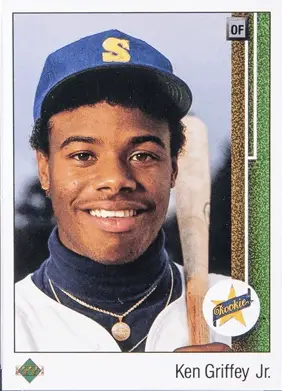
The 1989 Upper Deck Rookie: The Crown Jewel of the Hobby
If baseball cards had a Mount Everest, it would be the 1989 Upper Deck #1 Ken Griffey Jr. rookie. Graded PSA 10, it’s sold for over $3 million—more than some vintage Mantle or Mays cards. But why this one? Upper Deck’s 1989 set wasn’t just another release; it was a revolution. Printed on high-quality cardstock with a glossy finish and sharp photography, it felt like a luxury item in a world of flimsy Topps and Fleer. The photo itself—a full-bleed action shot of Griffey mid-leap, glove outstretched—isn’t just a portrait; it’s a narrative. It tells a story of youth, exuberance, and the promise of greatness.
What’s often overlooked is the card’s role in Upper Deck’s rise. By putting Griffey front and center, the company didn’t just sell a card; it sold a lifestyle. The ’89 Upper Deck set became the gold standard for modern baseball cards, and Griffey’s rookie became its Mona Lisa. Even today, when collectors speak of “the perfect card,” they’re often referring to a PSA 10 Griffey—not because it’s flawless, but because it embodies the pinnacle of what a baseball card can represent: a bridge between eras, a piece of history that feels alive.
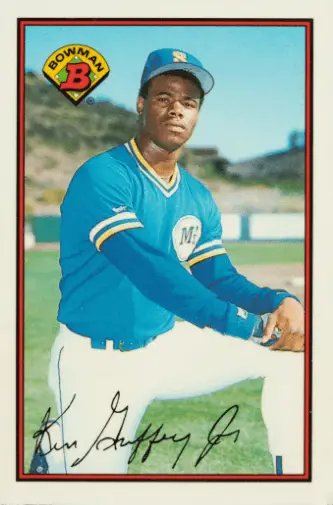
The 1989 Bowman Tiffany: The Phantom of the Hobby
If the Upper Deck rookie is the crown jewel, the 1989 Bowman Tiffany is the phantom—rare, elusive, and shrouded in mystery. Printed on thicker, shinier stock than the standard Bowman issue, the Tiffany set was a limited run, making it one of the scarcest modern cards in existence. A PSA 10 Griffey Tiffany has sold for over $1.2 million, and even raw copies trade hands for five figures. But what makes it so coveted?
The answer lies in the details. The Tiffany set was produced for a short time before Upper Deck’s dominance forced Bowman to halt production. The result? A card that feels almost mythical—like finding a first-edition Gutenberg Bible in a shoebox. The photo, a close-up of Griffey in a Mariners cap, is intimate, almost reverent. It’s not the flashy action shot of the Upper Deck; it’s a quiet moment, a glimpse into the soul of a player who made baseball feel personal.
Collectors chase the Tiffany not just for its rarity, but for the thrill of the hunt. Unlike the Upper Deck, which was mass-produced, the Tiffany feels like a relic from a forgotten time. It’s a card that whispers rather than shouts, and in a hobby dominated by loud, high-grade copies, that whisper is intoxicating.
The 1990 Score Rookie: The Underdog’s Delight
While the Upper Deck and Bowman Tiffany dominate the conversation, the 1990 Score rookie is the underdog that refuses to stay in the shadows. Often overshadowed by its flashier contemporaries, the Score rookie is a sleeper gem—affordable for most collectors, yet capable of delivering jaw-dropping returns. A PSA 10 has sold for over $50,000, and even high-grade raw copies trade for thousands. But why the sudden surge in interest?
The answer lies in the card’s design. Score’s 1990 set was known for its bold, almost garish color schemes and dynamic angles. The Griffey rookie, with its close-up shot and vibrant background, feels like a snapshot from a video game—energetic, modern, and unapologetically ’90s. It’s a card that doesn’t just depict Griffey; it channels the energy of the era. For collectors who grew up in the ’90s, the Score rookie is a time capsule, a piece of pop culture that transcends baseball.
What’s fascinating is how the Score rookie’s value has climbed not through hype, but through quiet appreciation. Unlike the Upper Deck or Tiffany, which are chased by deep-pocketed investors, the Score rookie is beloved by everyday collectors. It’s a card that feels attainable, yet still carries the weight of history. In a market where prices can swing wildly, the Score rookie is a steady performer—a reminder that sometimes, the best cards aren’t the most expensive, but the most meaningful.
The 1991 Fleer Ultra: The Sleeper King
If the Score rookie is the underdog, the 1991 Fleer Ultra is the sleeper king—a card that flies under the radar but delivers in spades. Printed on glossy, high-quality cardstock, the Ultra set was Fleer’s attempt to compete with Upper Deck, and Griffey’s rookie is one of its crown jewels. A PSA 10 has sold for over $25,000, and high-grade raw copies trade for thousands. But why does this card fly under the radar?
The answer lies in timing. By 1991, Griffey was already a superstar, and the Fleer Ultra set was overshadowed by the Upper Deck and Bowman Tiffany releases. The photo, a classic headshot of Griffey in his Mariners uniform, is elegant and timeless—less flashy than the Upper Deck, but more refined than the Score. It’s a card that feels like a bridge between the raw energy of the late ’80s and the polished professionalism of the early ’90s.
What’s fascinating about the Fleer Ultra is its dual appeal. For vintage collectors, it’s a piece of history—a card from a transitional era. For modern collectors, it’s a gateway into the hobby, a card that’s attainable yet still carries the weight of Griffey’s legacy. In a market where prices can be volatile, the Fleer Ultra is a steady, reliable investment—a card that rewards patience and appreciation.

The Deeper Allure: Why Griffey’s Cards Still Captivate
At the heart of Griffey’s enduring appeal is a paradox: his cards are both timeless and deeply personal. They’re not just investments; they’re emotional anchors. For collectors who grew up watching Griffey dominate the Mariners, these cards are a connection to a simpler time—when baseball was played in sun-drenched stadiums, when cards were traded on playgrounds, and when the game felt like a shared experience.
But there’s more to it than nostalgia. Griffey’s cards represent the golden age of baseball card production—a time when companies like Upper Deck, Bowman, and Fleer were innovating, pushing the boundaries of what a card could be. The Upper Deck rookie wasn’t just a card; it was a masterclass in design. The Bowman Tiffany wasn’t just a card; it was a relic from a forgotten era. These cards are artifacts of a cultural moment, pieces of history that tell a story beyond the player on the front.
And then there’s the human element. Griffey’s legacy is one of grace, humility, and joy. He played the game with a smile, a rarity in an era where intensity often overshadowed passion. His cards reflect that—whether it’s the exuberance of the Upper Deck rookie, the intimacy of the Bowman Tiffany, or the energy of the Score rookie, each card captures a different facet of Griffey’s personality. They’re not just collectibles; they’re portraits of a legend.
The fascination with Griffey’s cards isn’t just about their value—it’s about what they represent. They’re a reminder of a time when baseball felt like magic, when cards were more than just investments, and when a single image could capture the essence of a player, a team, and an era. In a hobby that’s increasingly dominated by numbers and grades, Griffey’s cards stand out because they feel alive. They’re not just pieces of cardboard; they’re windows into a world where baseball was more than a game—it was a way of life.
For collectors, the chase is part of the thrill. Whether it’s hunting for a PSA 10 Upper Deck rookie, tracking down a rare Bowman Tiffany, or holding a high-grade Score rookie, the journey is as rewarding as the destination. And in the end, that’s what makes Griffey’s cards so special. They’re not just investments; they’re treasures—pieces of history that connect us to the past, the present, and the joy of the game.