In the hallowed halls of baseball memorabilia, few artifacts command the same reverence as a Mickey Mantle signed baseball. The Mick, as he was affectionately known, wasn’t just a player—he was a legend, a switch-hitting colossus whose tape-measure home runs and magnetic charisma defined an era. Today, a Mantle autograph on a baseball isn’t just a collectible; it’s a tangible slice of history, a relic that whispers of a time when baseball was America’s pastime in its purest form. But how much is a Mickey Mantle signed baseball worth in today’s market? The answer isn’t as straightforward as you might think. It’s a story of condition, provenance, and the ever-shifting tides of collector demand—one that reveals as much about the hobby as it does about the man himself.
The Alchemy of Authentication: Why a Signature’s Story Matters More Than You Think
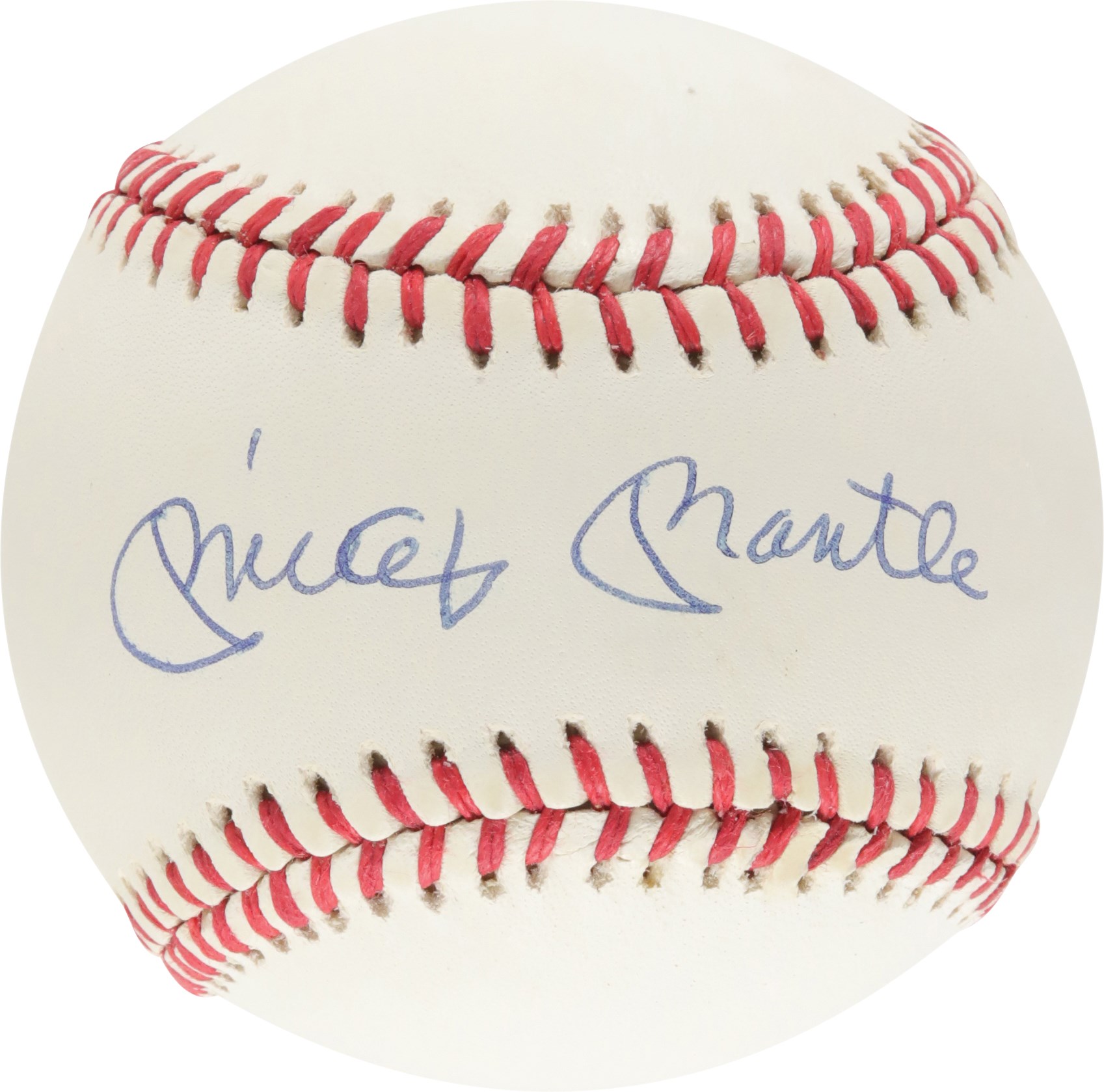
Not all Mickey Mantle signed baseballs are created equal. The first question any serious collector asks isn’t about the ball itself, but about the signature. Was it inscribed in Mantle’s prime, during the 1950s and 60s, when his hands were steady and his penmanship unmarred by time? Or was it penned decades later, when arthritis had begun to gnaw at his once-mighty grip? The difference is stark. A vintage signature—one captured in the heat of his playing days—can fetch upwards of $50,000, while a modern autograph, even one authenticated by a reputable service, might struggle to crack $5,000.
Authentication is the linchpin. A baseball signed in the presence of a Hall of Famer during a barnstorming tour is a unicorn. One that bears the unmistakable imprint of Mantle’s looping, confident script from a 1960s Topps card signing is a grail. But here’s the twist: even the most meticulous forgery can slip through the cracks. The market has seen its share of “expertly” forged Mantle signatures, only to be debunked years later when a new piece of evidence surfaces—a letter, a photograph, a contemporaneous account that proves the autograph’s origin. The lesson? Provenance isn’t just a buzzword; it’s the difference between a $10,000 ball and a $100 paperweight.
Condition: The Silent Multiplier of Value
Imagine holding a baseball that Mantle signed in 1961, the same year he clubbed 54 home runs and led the Yankees to another World Series title. The ball is pristine—no scuffs, no fading, the stitching tight and the leather supple. Now imagine the same ball, but it’s been displayed in a humid den for decades, the ink bleeding slightly, the leather cracked like parched earth. The first is a museum piece. The second is a cautionary tale.
Condition is the great equalizer in the world of signed baseballs. A Mantle autograph on a Rawlings Official Major League Baseball in Near Mint condition can command $30,000 or more. The same signature on a ball that’s been played with, stored improperly, or handled carelessly might sell for a fraction of that—$3,000 to $5,000, if it sells at all. Collectors obsess over the minutiae: the sharpness of the ink, the depth of the signature, the absence of wear on the ball’s surface. Even the type of ball matters. A baseball from Mantle’s era—pre-1970s, when the stitching was tighter and the leather thicker—holds more value than a modern reproduction, no matter how convincing the autograph appears.
And then there’s the matter of the ball’s origin. Was it signed during a game? In a private session? At a charity event? The context adds layers of narrative that collectors crave. A baseball signed in the dugout after a game-winning home run carries a story that a generic autograph on a store-bought ball simply can’t match.
The Market’s Pendulum: Trends That Shift Like the Wind
Baseball memorabilia is a fickle beast. What’s hot today might be passé tomorrow, and vice versa. The value of a Mickey Mantle signed baseball is as much about timing as it is about quality. In the early 2000s, as the internet auction boom took hold, prices for Mantle autographs skyrocketed. A well-documented signature could fetch $40,000 or more. But by the late 2010s, the market had cooled. Over-saturation, a glut of lower-grade signatures, and the rise of alternative investments like cryptocurrency led to a correction. Prices dipped. Some collectors panicked. Others saw an opportunity.
Today, the pendulum is swinging back. The pandemic fueled a renewed interest in tangible collectibles, and Mantle’s legacy—bolstered by documentaries, biographies, and the enduring allure of the Yankees dynasty—has never been stronger. Auction houses like Heritage and SCP report record sales for top-tier Mantle autographs. A 1950s-era signed baseball in Gem Mint condition sold for $63,000 in 2022. A 1960s Topps card signing ball fetched $45,000. But here’s the kicker: the market isn’t just about the highest grades. Mid-tier signatures—those in Very Good to Excellent condition—are seeing renewed interest from younger collectors who can’t afford the six-figure rarities but still want a piece of history. The result? A democratization of sorts, where the middle tier of Mantle autographs is becoming more accessible, even as the top tier soars to new heights.
The Psychology of the Chase: Why Collectors Pay What They Do
To understand why a Mickey Mantle signed baseball can command such staggering prices, you have to understand the psychology of the chase. For many collectors, owning a Mantle autograph isn’t just about investment potential. It’s about connection. It’s about holding a piece of the past, a fragment of a time when baseball was played under floodlights that cast long shadows across the diamond, when the crack of the bat was the soundtrack of summer, and when a man named Mickey could turn a simple sphere of cork and horsehide into a legend with a single signature.
There’s also the thrill of the hunt. The best Mantle autographs aren’t bought; they’re earned. They’re found in dusty attics, unearthed at estate sales, or secured after years of bidding wars on eBay. The stories behind these discoveries—how a collector tracked down a long-lost relative who once met Mantle, or how a ball was pulled from a shoebox in a forgotten corner of a garage—add to the allure. Each signature carries a narrative, and in a world where so much is digital, that tangibility is priceless.
And then there’s the status. Owning a Mickey Mantle signed baseball isn’t just a flex; it’s a badge of honor. It signals that you’re part of an exclusive club, one that understands the weight of history. It’s why some collectors will pay a premium for a signature that’s been authenticated by multiple experts, or why they’ll go to great lengths to verify a ball’s provenance. The fear of buying a forgery isn’t just financial—it’s existential. To own a fake Mantle autograph is to own a lie, and no collector wants that stain on their legacy.
The Future: What’s Next for Mantle’s Market?
The next decade will be pivotal for Mickey Mantle signed baseballs. As the generation that saw him play fades, the supply of authenticated autographs will inevitably dwindle. The market will tighten. Prices will rise. But here’s the paradox: the more Mantle’s legend grows, the more his signature will be sought after—and the more the market will have to adapt. We’re already seeing the rise of fractional ownership, where collectors pool resources to buy high-end pieces. We’re seeing a surge in demand for lesser-known Mantle autographs—letters, checks, even hotel receipts—anything that bears his name. And we’re seeing a new wave of collectors, younger and more diverse, who view Mantle not just as a Yankee immortal, but as a cultural icon whose story transcends sports.
The question isn’t whether Mickey Mantle signed baseballs will retain their value. It’s how high they’ll go. And for those who understand the alchemy of authenticity, condition, and narrative, the answer might just be: higher than anyone imagined.
The next time you see a Mickey Mantle signed baseball, don’t just see a ball with a signature. See a time capsule. See a piece of history that’s been touched by greatness. See an investment that’s as much about passion as it is about profit. And remember: the Mick didn’t just sign baseballs. He signed dreams. And those dreams, like his tape-measure home runs, are still soaring.