It’s a familiar refrain in the baseball card collecting world: “Rafael Palmeiro’s rookie cards are undervalued.” You’ve heard it at shows, seen it in forums, and maybe even whispered it while flipping through a binder at a local card shop. The sentiment isn’t unfounded. After all, Palmeiro compiled over 3,000 hits, 569 home runs, and 1,835 RBIs—numbers that place him among the game’s most prolific switch-hitters. Yet, when you compare his rookie card market presence to contemporaries like Ken Griffey Jr. or Barry Bonds, the disparity feels glaring. Is this just another case of market myopia, or is there something deeper at play? Let’s unpack the Palmeiro rookie card phenomenon, where nostalgia clashes with modern valuation metrics, and where the story behind the cards might be just as compelling as the stats on the back.
The Palmeiro Paradox: Talent That Never Translated to Card Value
Rafael Palmeiro’s rookie cards—particularly his 1987 Donruss #43 and 1987 Fleer #54—are often described as “sleepers” or “hidden gems.” But why do they remain undervalued despite his Hall of Fame-caliber production? The answer lies in a confluence of timing, perception, and market psychology. Unlike Griffey, whose rookie cards skyrocketed in the 1990s due to his transcendent appeal and rookie card scarcity, Palmeiro entered the hobby during a period when the market was still recovering from the 1980s boom-and-bust cycle. His rookie cards, while well-produced for the era, lacked the “wow” factor that drives speculative fervor.
Consider the 1987 Donruss set. It was a solid vintage issue, but not one that commanded premium prices like Topps’ flagship sets. Palmeiro’s card, while attractive, didn’t feature the flashy refractors or autograph parallels that collectors crave today. Instead, it was a straightforward base card—functional, but not flashy. This lack of “hype” cards in his rookie year meant that Palmeiro’s cards never benefited from the kind of early speculative buying that propelled other stars. The market simply didn’t know what it had yet.
Then there’s the shadow of his later career. Palmeiro’s infamous 2005 Congressional testimony, where he vehemently denied steroid use while under oath, cast a long pall over his legacy. Suddenly, the narrative around his cards shifted from admiration to ambivalence. Collectors who once prized his cards for their on-field achievements now hesitated, unsure whether to associate their collections with a player whose reputation had been irreparably tarnished. The result? A market that never fully embraced his cards, despite his statistical dominance.
The 1987 Donruss #43: A Card Caught in the Crossfire
The 1987 Donruss #43 is Palmeiro’s most iconic rookie card, and it’s the one that garners the most attention from collectors. In PSA 10 Gem Mint condition, it typically sells for between $50 and $100, a far cry from the four-figure prices commanded by Griffey’s 1989 Bowman or Bonds’ 1987 Topps. But is this valuation justified, or is it a case of market inertia?
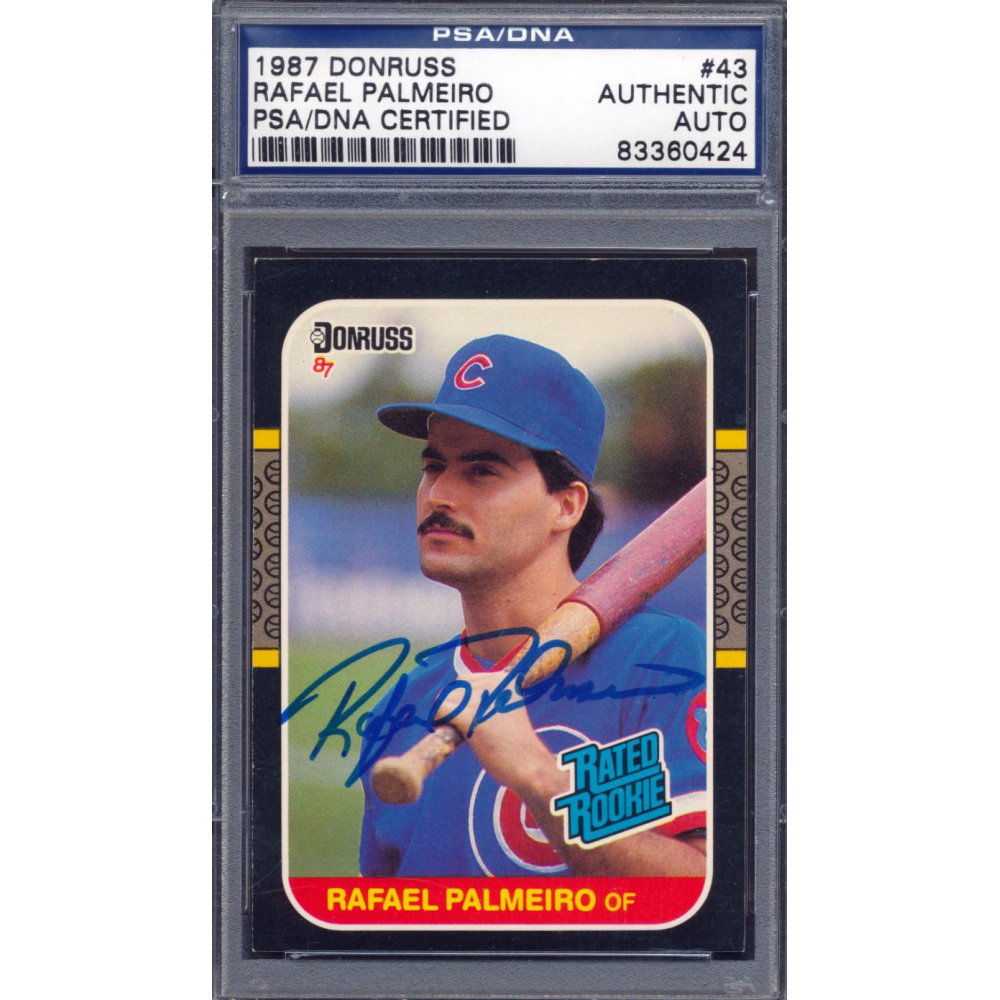
Several factors contribute to the card’s relatively modest price point. First, the 1987 Donruss set, while popular among vintage collectors, isn’t as universally sought-after as Topps or Fleer issues from the same era. The set’s design, while clean and functional, lacks the bold aesthetics that make other vintage cards stand out. Palmeiro’s card, in particular, is often overshadowed by the set’s more iconic rookies, like Greg Maddux and Mark McGwire. This lack of star power in the set itself means that Palmeiro’s card doesn’t benefit from the halo effect that drives demand for other rookie cards.
Second, the market for Palmeiro’s cards is heavily influenced by his polarizing legacy. While some collectors view his cards as undervalued opportunities, others see them as tainted by his later infamy. This divide creates a fragmented market where prices fluctuate based on collector sentiment rather than pure supply and demand. In recent years, however, there’s been a subtle shift. As vintage collecting becomes more about nostalgia and less about pure investment potential, Palmeiro’s cards are starting to attract a new generation of collectors—those who appreciate his on-field achievements without being swayed by the controversies of his later years.
Parallels and Autographs: The Hidden Gems of Palmeiro’s Rookie Cards
While Palmeiro’s base rookie cards remain accessible, his parallel and autograph variants tell a different story. Cards like the 2005 Topps Heritage Chrome Refractor /556 (#THC37) or signed copies of his 1987 Donruss rookie have seen sporadic spikes in interest, particularly among modern collectors who appreciate the shimmer of refractors or the allure of autographed memorabilia.

The 2005 Topps Heritage set, released decades after Palmeiro’s rookie year, is a fascinating case study in how modern collecting trends can resurrect interest in older players. The Chrome Refractor parallels, with their iridescent sheen, appeal to collectors who enjoy the visual spectacle of modern cards but still want to connect with vintage players. For Palmeiro, this set provided a second act—a chance to be rediscovered by a new audience. The Refractor /556, in particular, has seen prices climb steadily, with high-grade examples selling for $100 or more. This isn’t because Palmeiro’s legacy has suddenly been rehabilitated, but because the card itself fits neatly into the modern collecting zeitgeist.
Autographed copies of Palmeiro’s rookie cards are another area where demand is quietly growing. While signed cards from his playing days are rare, modern autograph relics—like the one offered by Pristine Auction—have become sought-after by collectors who want a tangible connection to his career. The appeal here is less about the card’s condition and more about the story it tells. A signed Palmeiro rookie card isn’t just a piece of cardboard; it’s a relic of a player who, for better or worse, defined an era of baseball.
Market Trends: Is Now the Time to Invest?
The question on every collector’s mind is whether Palmeiro’s rookie cards are poised for a resurgence. The answer depends on which lens you’re looking through. For vintage purists, Palmeiro’s cards will always be a niche interest—something to be picked up at a bargain but not a centerpiece of a collection. For modern collectors, however, there’s an opportunity to acquire a piece of baseball history at a fraction of the cost of more hyped players.
One trend working in Palmeiro’s favor is the growing appreciation for switch-hitters in the collecting world. Players like Eddie Murray and Chipper Jones, who also excelled from both sides of the plate, have seen their cards gain traction in recent years. Palmeiro, with his 3,000-hit milestone and switch-hitting prowess, fits neatly into this narrative. As collectors seek out underrated switch-hitters, Palmeiro’s cards could benefit from the association.
Another factor is the broader vintage market’s shift toward “affordable” stars. As prices for top-tier vintage cards continue to climb, collectors are increasingly looking for alternatives that offer similar statistical pedigrees without the astronomical price tags. Palmeiro’s rookie cards fit this bill perfectly. They’re not cheap, but they’re not out of reach for the average collector, and they offer a chance to own a piece of baseball history without breaking the bank.

The Deeper Allure: Why Palmeiro’s Cards Still Fascinate
Beyond the numbers and market trends, there’s something quietly compelling about Palmeiro’s rookie cards. They represent a bridge between eras—a time when baseball cards were still a grassroots hobby, not a speculative asset class. Collecting Palmeiro’s cards isn’t just about owning a piece of cardboard; it’s about owning a piece of baseball’s soul, warts and all.
There’s also the element of redemption. For collectors who grew up watching Palmeiro dominate the game, his rookie cards are a reminder of a time when baseball felt simpler, before the steroid era cast a long shadow. They’re a chance to reconnect with the purity of the game, even if the player’s legacy is complicated. In a hobby that’s increasingly driven by investment potential and resale value, Palmeiro’s cards offer something rarer: a connection to the past.
And perhaps that’s the real reason his cards still fascinate. They’re not just investments. They’re artifacts of a bygone era, when baseball cards were about passion, not portfolios. Whether Palmeiro’s rookie cards ever reach the heights of his contemporaries is beside the point. What matters is that they exist—a tangible link to a player who, for better or worse, left an indelible mark on the game.
In the end, Rafael Palmeiro’s rookie cards may never command the prices of a Griffey or a Bonds. But that doesn’t mean they’re not worth owning. For the right collector, they offer something far more valuable: a piece of baseball history, unvarnished and unfiltered. And in a hobby that’s increasingly driven by hype and speculation, that’s a rare commodity indeed.