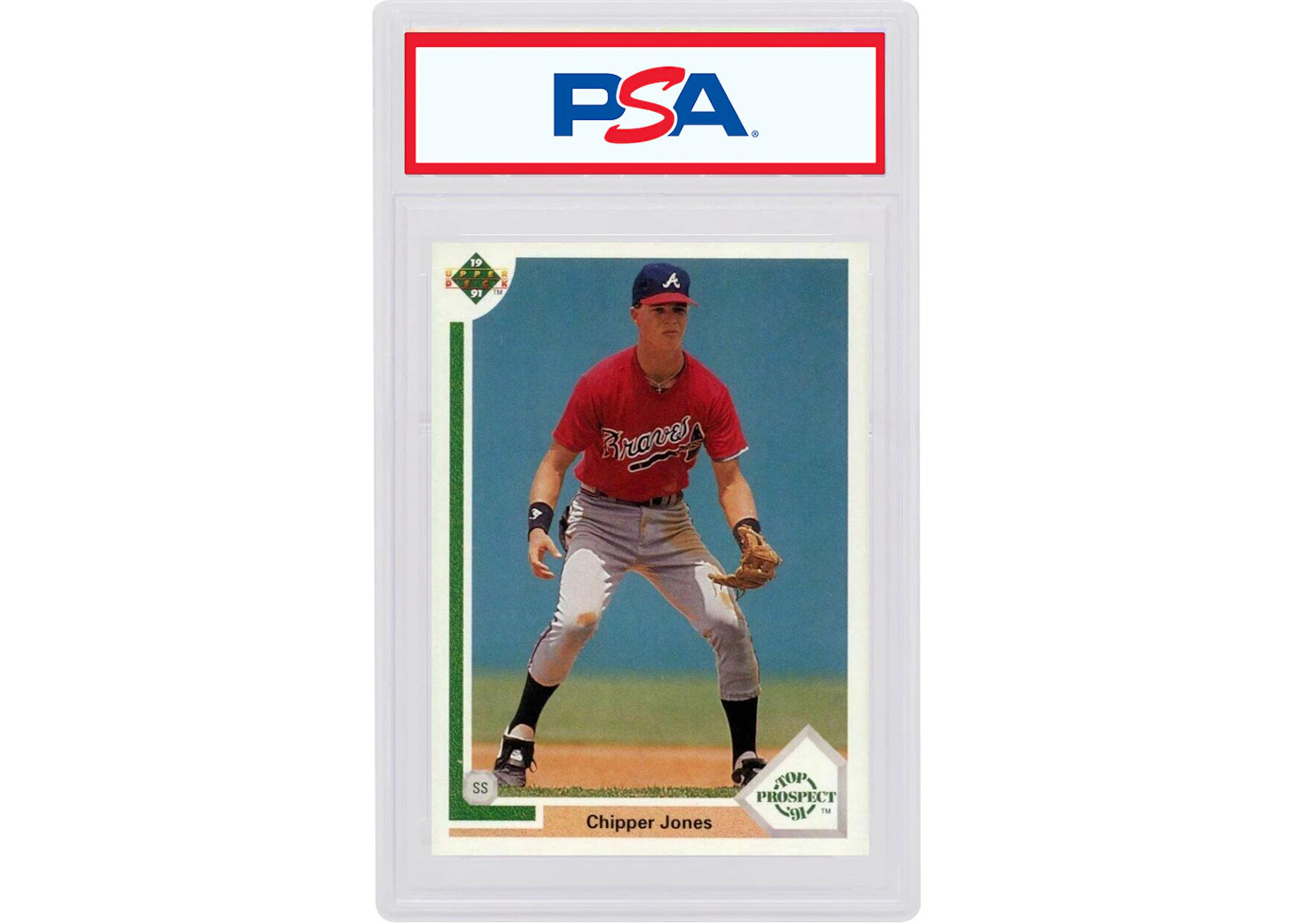
In the pantheon of baseball card collecting, few rookie cards command the kind of reverence reserved for those that encapsulate a player’s immediate ascension to greatness. The 1991 Upper Deck Chipper Jones rookie card is one such treasure—a glossy, vibrant snapshot of a future Hall of Famer frozen in the amber of his debut season. But here’s the kicker: is this card merely a nostalgic keepsake, or does it harbor the kind of long-term value that could make it a cornerstone of any serious collection? The answer isn’t as straightforward as you might think. While Jones’ Hall of Fame pedigree is undeniable, the card’s market trajectory is a labyrinth of variables, from grading quirks to the whims of the collecting public. So, let’s dive into the heart of the matter and dissect whether this rookie card is a blue-chip investment or a fleeting fancy.
The Lure of the Legend: Chipper Jones’ Hall of Fame Pedigree
Chipper Jones didn’t just stumble into Cooperstown; he waltzed in with the swagger of a switch-hitting virtuoso who could do it all—from driving in runs to turning double plays with the grace of a seasoned ballroom dancer. Drafted first overall by the Atlanta Braves in 1990, Jones debuted in 1995 and wasted no time announcing himself to the baseball world. By the time his career wound down in 2012, he had amassed a .303 batting average, 468 home runs, and an MVP award in 1999. His induction into the Hall of Fame in 2018 cemented his legacy, but for collectors, the question lingers: does that legacy translate directly into the value of his rookie card?
For many, the answer is a resounding yes. A Hall of Famer’s rookie card is often the crown jewel of a collection, a tangible link to a player’s immortalized greatness. The 1991 Upper Deck Chipper Jones rookie card, with its iconic action shot of Jones mid-swing, captures the essence of his prodigious talent. The card’s design—crisp, colorful, and brimming with the energy of the early ’90s—only enhances its allure. But here’s where the plot thickens: not all Hall of Fame rookie cards are created equal. Some, like the 1952 Mickey Mantle, become mythic due to their scarcity and historical context. Others, like the 1985 Don Mattingly, remain desirable but don’t command the same stratospheric prices. Where does the 1991 Upper Deck Chipper Jones fall on this spectrum?
The Grading Gauntlet: PSA, BGS, and the Quest for Perfection
If you’re considering adding the 1991 Upper Deck Chipper Jones rookie card to your collection, prepare for a gauntlet of grading challenges. The card’s value is inextricably tied to its condition, and the difference between a PSA 9 and a PSA 10 can be the gap between a modest profit and a life-changing score. Professional grading services like PSA and BGS have become the arbiters of value in the collecting world, and their assessments can make or break a card’s marketability.
For instance, a PSA 10 Gem Mint example of the 1991 Upper Deck Chipper Jones rookie card can fetch upwards of $1,000, while a PSA 9 Near Mint-Mint might linger in the $200-$300 range. The challenge? Finding a card that meets the stringent criteria for a 10. Centering must be near-perfect, corners must be razor-sharp, and the surface must be devoid of any flaws, no matter how minor. Even the slightest imperfection—a tiny crease, a speck of print defect—can relegate a card to the dreaded “9” tier, where its value takes a significant nosedive.
This grading gauntlet isn’t just a test of the card’s physical condition; it’s a test of the collector’s patience and discernment. Hunting for a PSA 10 is like searching for a needle in a haystack, especially when you consider the sheer volume of 1991 Upper Deck Chipper Jones rookie cards that have flooded the market over the years. The early ’90s were a golden age for baseball card production, and Upper Deck’s innovative design and high-quality printing made their cards instant classics. But that popularity also means competition is fierce, and the supply of pristine examples is finite.
The Market’s Mood Swings: Supply, Demand, and the Collector’s Whims
Even the most hallowed rookie cards aren’t immune to the ebb and flow of the market. The 1991 Upper Deck Chipper Jones rookie card is no exception. While its Hall of Fame status provides a sturdy foundation of demand, the card’s value is still subject to the whims of collectors and the broader economic tides. For example, the card’s price can fluctuate based on trends in the sports memorabilia market, the performance of Jones’ former teammates, or even the introduction of new, more modern rookie cards featuring current stars.
Consider the case of the 1986 Fleer Michael Jordan rookie card, which saw its value skyrocket during the ’90s basketball boom before experiencing a correction in the early 2000s. The 1991 Upper Deck Chipper Jones rookie card could face a similar trajectory if the market shifts or if collectors begin to favor newer, shinier prospects. The key to navigating these mood swings is understanding the card’s long-term potential. Unlike speculative investments, a Hall of Famer’s rookie card is less likely to become worthless, but its growth may plateau if the collecting public’s interest wanes.
Another factor to consider is the card’s role in the broader ecosystem of baseball cards. The 1991 Upper Deck set is vast, with hundreds of cards featuring rookies, veterans, and team-specific subsets. While Chipper Jones’ card is undoubtedly one of the crown jewels, it competes for attention with other iconic rookies like Frank Thomas and Ken Griffey Jr. The presence of these other stars can either drive up demand for the entire set or dilute the focus on individual cards like Jones’. It’s a delicate balance, and collectors must weigh the card’s standalone appeal against its place in the larger market.
The Investment Angle: Is It Worth the Gamble?
For those viewing the 1991 Upper Deck Chipper Jones rookie card through the lens of investment, the calculus is both exciting and fraught with uncertainty. On one hand, the card’s Hall of Fame status and the nostalgia factor make it a compelling long-term hold. Baseball cards, like fine wine, often appreciate over time, especially when tied to a player of Jones’ caliber. The card’s design, scarcity of high-grade examples, and the emotional connection to one of the game’s most beloved switch-hitters all contribute to its investment potential.
On the other hand, the card’s market is not without its risks. The grading process, while essential, can be inconsistent, and a single misgraded card can skew the market. Additionally, the rise of relic and autograph cards has shifted some collector interest away from traditional rookie cards, potentially dampening demand for the 1991 Upper Deck Chipper Jones. There’s also the question of liquidity—while the card is desirable, selling a high-grade example quickly and at a premium isn’t always guaranteed.
The savvy collector must ask themselves: Are they holding the card for the long haul, banking on its appreciation as Jones’ legacy grows? Or are they looking for a shorter-term play, capitalizing on the card’s current desirability before the market potentially cools? The answer depends on one’s risk tolerance and collecting philosophy. For those who believe in the timeless appeal of baseball cards and the enduring legacy of Hall of Famers, the 1991 Upper Deck Chipper Jones rookie card is a gamble worth taking.
The Wildcard: Condition and Rarity in the Modern Era
In the world of baseball card collecting, condition is king, and rarity is the ace up the sleeve. The 1991 Upper Deck Chipper Jones rookie card is no exception. While the set was mass-produced, the number of cards that have survived in near-perfect condition for nearly three decades is surprisingly low. This scarcity of high-grade examples is a driving force behind the card’s value, but it also introduces a wildcard: the potential for future discoveries.
As collecting communities grow and grading standards evolve, it’s possible that new high-grade examples of the 1991 Upper Deck Chipper Jones rookie card could surface, flooding the market and temporarily suppressing prices. Conversely, advancements in grading technology or changes in collecting trends could drive demand even higher, particularly if the card becomes a sought-after piece in themed collections (e.g., Braves memorabilia, switch-hitters, or ’90s stars).
The rarity of the card is further complicated by the fact that Upper Deck’s 1991 set was one of the first to use high-quality photography and printing techniques, making it a standout in an era of cardboard chaos. This innovation not only endeared the set to collectors but also ensured that the cards would age better than their contemporaries. The result? A card that not only looks great today but has the potential to look even better decades from now, assuming it’s properly preserved.
Final Pitch: To Hold or to Sell?
The 1991 Upper Deck Chipper Jones rookie card is a study in contrasts—a blend of timeless appeal and market volatility, of Hall of Fame pedigree and grading uncertainty. For collectors who prize the card for its sentimental value, its connection to one of the game’s most beloved players, it’s a no-brainer hold. The emotional return on investment is immeasurable, and the card’s place in baseball history is secure.
For investors, the calculus is more nuanced. The card’s long-term potential is undeniable, but the path to profitability is fraught with challenges. Grading, market trends, and the ever-present specter of oversupply all play a role in determining whether the 1991 Upper Deck Chipper Jones rookie card will be a home run or a ground ball. The key is to approach the card with a clear strategy—whether that’s holding for the long term, flipping for a quick profit, or using it as a cornerstone of a larger collection.
One thing is certain: the 1991 Upper Deck Chipper Jones rookie card is more than just a piece of cardboard. It’s a time capsule, a testament to greatness, and a potential goldmine. Whether it’s worth the gamble depends entirely on what you’re looking to get out of it. But if history is any indication, the cards that stand the test of time are those that capture not just a player’s skill, but the spirit of an era. And in that regard, the 1991 Upper Deck Chipper Jones rookie card is a masterpiece.