From the silent hum of deep woods to the frost-slicked edges of a taiga, there exists a persistent whisper. An unseen world operates in concert with the familiar trees, paths, and scents we know so well. This hidden realm is often revealed through fleeting snapshots, chance encounters with technology placed solely to glimpse the magnificent. Game cameras, positioned as sentinels among the foliage, capture moments otherwise lost to time or observation. Understanding their function is less about revealing secrets and more about appreciating the complex choreography of nature, observed through an intricate dance of light, motion, and electronic intelligence. These are not merely cameras; they are silent guardians of wildlife corridors, passive observers of behaviours, and sophisticated tools for insight.
Chapter One: The Unseen Spectrum – Infrared Technology and Night Vision
Most game cameras operate primarily in the infrared (IR) spectrum, functioning effectively in near-total darkness. Imagine a world bathed in invisible light. This is the environment IR illuminators create. These specialized components, situated within the camera housing, typically consist of two arrays of powerful, often red, LEDs emitting in the near-infrared range (around 850nm). Since most game animals’ fur reflects relatively little visible or near-infrared light, they appear almost black against a brighter background. This stark contrast enables the camera’s sensitive Charge-Coupled Device (CCD) or Complementary Metal-Oxide-Semiconductor (CMOS) sensor to capture the image. The emitted IR light reflects off the animal and is picked up by the sensor, effectively substituting visible light for the camera’s view in near-total darkness.
Chapter Two: The Vigilant Sentinel – Motion Sensors: Pyroelectricity and PIR
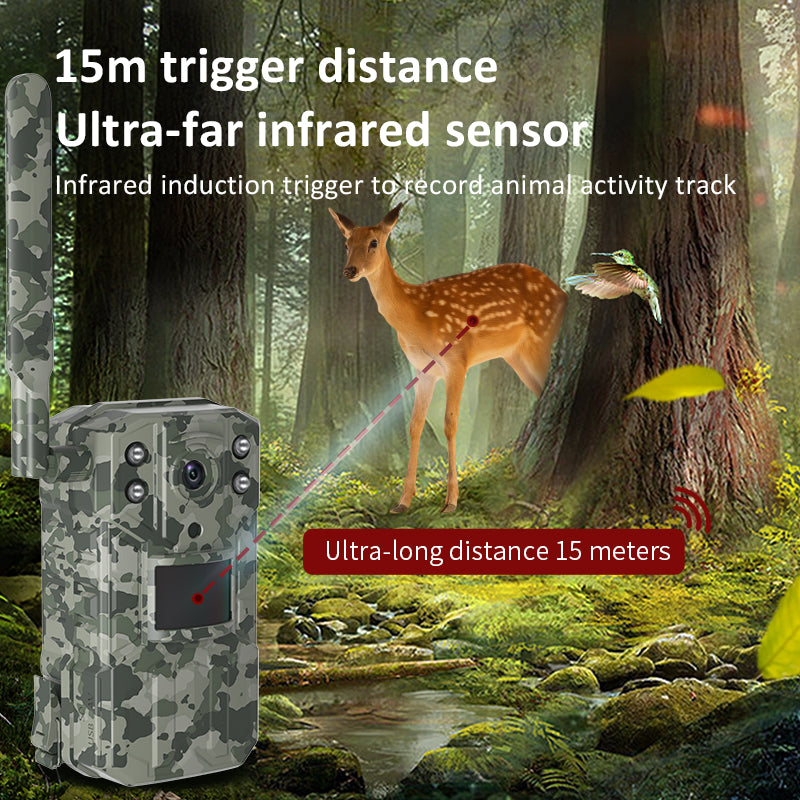
How does a piece of equipment the size of a small brick discern movement through complete obscurity? The answer lies in Pyroelectric Infrared Sensors, more commonly known as Passive Infrared (PIR) sensors. These unassuming marvels work through the principle of heat. Everything possesing a temperature emits infinitesimal infrared radiation. Warm-blooded animals, particularly mammals, generate significantly more heat than their surroundings. As an animal enters the sensor’s field of view, the minute change in the infrared energy received is detected. The sensor splits its field of view and compares the thermal energy received from different parts. A moving animal disturbs this balance, creating a temperature differential across the sensor’s sensitive plane. This detected ‘motion’ or heat differential triggers the camera’s response. It’s a passive process; the device does not emit energy to detect changes, relying solely on the animal’s inherent heat signature.
Chapter Three: The Capturing Mechanism – Camera Mechanics and Lens Design
Triggered by the PIR sensor, what happens next is the essence of capturing the fleeting moment? Once active, the camera rapidly deploys its lens system – a critical component designed to minimize glare and maximize the chances of capturing a clear image under challenging low-light conditions. Many cameras feature a secondary protective lens cover or door that swings open, exposing the primary lens optimized for infrared photography or low-light visibility. The mechanics behind this unfolding vary; simple hinges or sophisticated motorized systems exist in more advanced models, designed to operate quickly and quietly, minimizing the chance of startling any passing creature. Following lens deployment, the image capture process begins. Depending on the technology, image data may be transmitted wirelessly (Wi-Fi or Cellular) or captured locally on dedicated SD or SDHC memory cards. The latter remains popular for cost-effectiveness and large storage capacity.
Chapter Four: Powering the Unseen: Batteries and Alternative Energy Sources
A camera strategically placed deep within a wildlife corridor is not merely a passive detector; it is an endurance athlete requiring power sources that prioritize stealth and longevity. The most common solution is the internal lithium battery, prized for its high energy density relative to its size and weight, enabling lengthy operation without physical access. However, the most significant advancement in trail camera technology often lies in its power architecture. Many models boast sophisticated power management systems. These systems employ intelligent power cycling – activating the motion sensor, briefly illuminating a red IR warning flash (a feature photographers call lens flare minimization), capturing the necessary image (either as a JPEG or potentially a short video file), and then immediately returning to the ultra-low-power standby mode to conserve energy. Furthermore, a growing number of advanced cameras utilize solar panels coupled with sophisticated charge controllers. These systems harness the sun’s energy during the day, charging internal batteries for extended operation without the need for battery replacement, significantly reducing environmental impact and logistical burden on hunters and researchers.
Chapter Five: The Processing Heart – Image Capture Fundamentals
The captured image, whether stored directly on the card or transmitted via a cellular network, relies on the image sensor – the heart of the camera’s electronics. CCD sensors were pioneers but CMOS sensors have largely become the industry standard due to their faster processing speed, lower power consumption, and improved image quality at lower light levels. A specialized flash unit, typically the IR emitters used for detection, sometimes provides fill-flash illumination – emitting a brief burst of infrared light just before image capture. This supplemental light serves to brighten the animal in the shot, although it’s invisible to the naked eye, thereby improving image quality by balancing the animal (a warmer object) against the cooler background (a less IR-reflective environment). Some models offer multiple flash modes or can combine internal processing with actual visible flashes, though the latter can spook animals accustomed only to the infrared trigger. The processing demands of generating and storing high-resolution images, even in low light, necessitate powerful embedded processors, further contributing to the device’s ‘brain’ capacity.
Chapter Six: Mind the Trigger – Delays and Settings Explained
Understanding the camera’s response time, measured in milliseconds, is crucial. This setting dictates the delay between the moment motion is detected by the PIR sensor and the precise moment the flash activates and the image is captured. Some users may need a slightly longer delay to allow time for potential follow-up animals (e.g., a secondary animal after a primary one), while others seek to minimize the flash duration or prevent the trigger flash from scaring animals before the image is taken (though infrared flashes aren’t visible, the sudden activation might startle some less wary creatures). These nuanced settings allow for tailoring the camera’s behaviour to specific hunting scenarios or observation goals, enhancing its effectiveness. Other settings often configurable include the sensitivity of the PIR sensor, the dwell time before the camera returns to standby, and, crucially, the trip count limit – how many pictures the camera can take before needing to stop, replacing batteries (or recharging), or inserting a new memory card. These adjustable parameters transform the basic device into a highly versatile surveillance tool.
Chapter Seven: Aiming for Results – Memory and Placement Considerations
At the heart of successful trail camera deployment is the memory card and its capacity. Standard Secure Digital (SD) and SDHC cards offer ample storage for numerous high-resolution images even when compressed, making them the go-to choice. Choosing the right location, however, remains paramount. Visibility from game travel routes – established paths, trails, river corridors, mineral licks, or water sources – combined with concealment from typical threats (thieves, animals unfamiliar with technology) dictates where the camera should reside. Its angle matters too, typically aimed slightly upward to capture animals coming up from the ground and downward slightly to ensure animals are not looking horizontally directly at the camera’s lens, which can introduce perspective distortion. Proper camouflage and protection from the elements (rain, snow, extreme temperatures) further ensure reliable data capture and extend the device’s operational lifespan in demanding environments. It’s this thoughtful deployment coupled with technical understanding that transforms a $200 gadget into an invaluable tool for insight.
Chapter Eight: The Silent Observer’s Purpose – Research and Conservation
The reach extending far beyond trophy hunting reveals a deeper dimension. Game cameras are powerful tools for researchers and conservationists. Studies employing camera trapping provide invaluable data on elusive species’ populations, behaviours, territories, and movement patterns – information previously difficult or impossible to gather with traditional observation methods. Identifying individual animals through unique markings (like bear claw prints or distinct coat patterns on leopards) becomes feasible via consistent camera placement along known animal paths. Furthermore, the cameras offer non-invasive means to monitor biodiversity, documenting mammal species composition in specific habitats. Unveiling populations of endangered animals like tigers or wolves, observing natural behaviours such as elk calving, or tracking the presence of invasive species provides crucial scientific knowledge. The humble game camera, born from a need for quiet observation, serves as an unobtrusive window into the daily lives and nocturnal adventures of countless creatures, contributing significantly to our understanding of the natural world and informing conservation strategies based on observed, unbiased data.