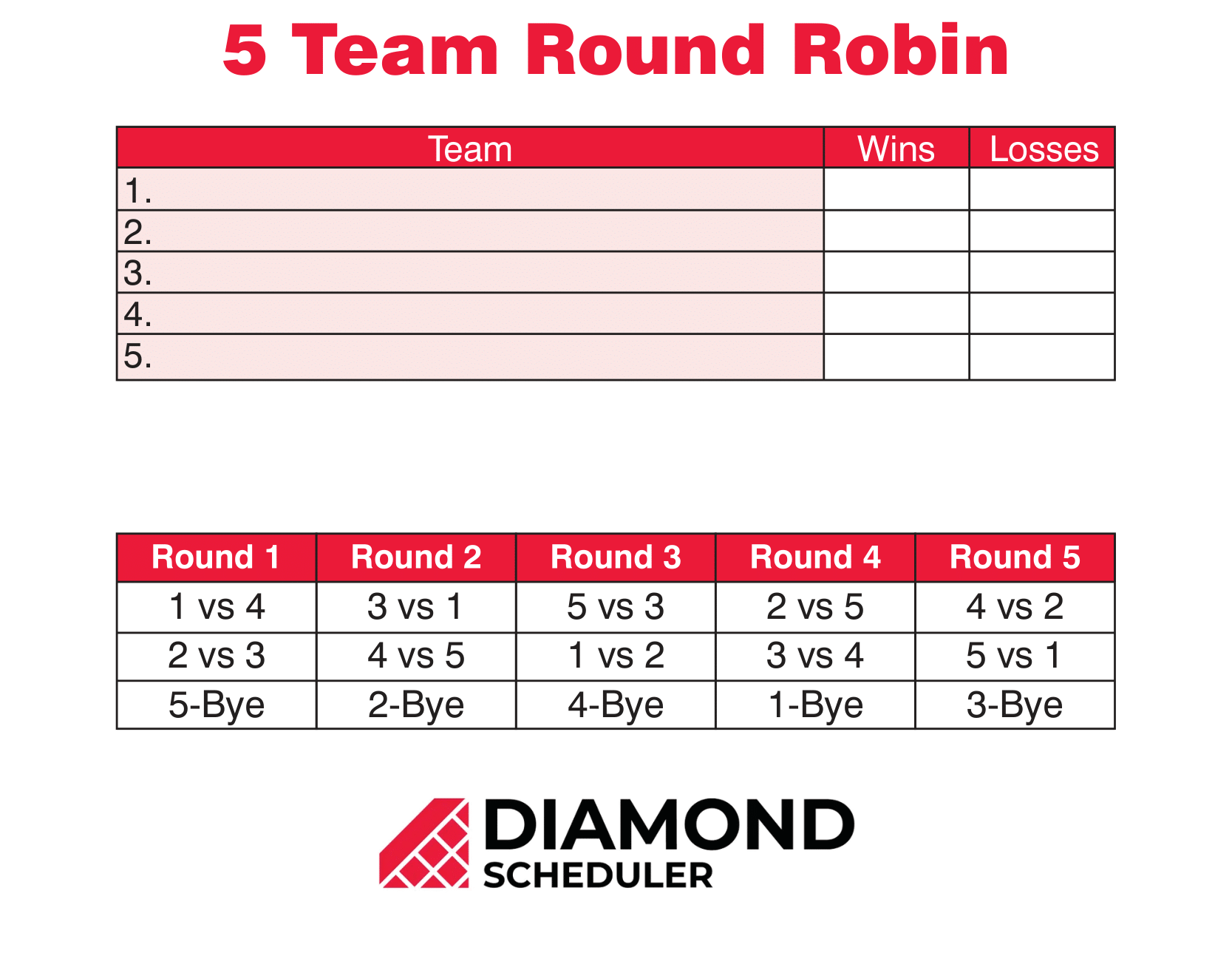
Imagine a baseball diamond where every team, no matter how mighty or modest, gets the same number of swings at glory. No early exits. No late comebacks snatched from the jaws of mediocrity. This is the promise of the 5-team round robin tournament—a format where fairness isn’t just a buzzword; it’s the architecture of the competition itself. In a sport often defined by streaks and slumps, where one bad inning can derail a season, the round robin offers something radical: a chance for every team to write its own narrative, free from the tyranny of a single-elimination upset or a double-elimination marathon. It’s not just a tournament format. It’s a crucible of consistency, a proving ground where the best team rises not by luck, but by the relentless application of skill over time.
The Round Robin as a Microcosm of Baseball’s Soul
Baseball is a game of patience and precision, where a .300 hitter fails seven times out of ten and a pitcher’s perfect game can unravel in a single wild pitch. The round robin mirrors this reality. Each team plays every other team exactly once, accumulating wins and losses like innings in a game that refuses to end prematurely. There are no do-overs, no second chances—just the cumulative weight of every pitch, every swing, every defensive gem. It’s baseball distilled to its purest form: a test of endurance, adaptability, and the quiet art of outlasting your rivals without ever facing elimination. In this format, the team that dominates isn’t just the one with the flashiest players; it’s the one that can sustain excellence across the entire gauntlet.
The Illusion of Predictability—and Why It’s Deceptive
Critics of the round robin often dismiss it as a snoozefest, a format where the strongest teams inevitably rise to the top, draining the drama from the proceedings. But this is a misconception born of a misunderstanding. The round robin doesn’t eliminate unpredictability; it magnifies it. Consider a scenario where Team A, the preseason favorite, stumbles against an underdog in the first matchup. In a single-elimination tournament, that loss could be a death knell. In a round robin, it’s merely a setback—a data point in a larger story. The format rewards resilience. It forces teams to adjust, to learn, to evolve. The underdog isn’t just a one-hit wonder; it’s a contender with a chance to prove its mettle over and over again. The round robin doesn’t guarantee fairness; it creates the conditions for it to emerge organically from the chaos of competition.
The Psychological Chess Match of Scheduling
Behind the scenes, the round robin is as much a tactical puzzle as it is a sporting event. Coaches must navigate the labyrinth of matchups, deciding when to rest key players, when to deploy experimental lineups, and how to manage the psychological toll of back-to-back games. A team that peaks too early might find itself spent when the real battles begin. One that plays it too safe could be outmaneuvered by rivals who seize momentum. The schedule becomes a weapon. A team that draws a tough early slate might gain an edge by facing the best competition first, while another might prefer to build confidence against weaker foes before the gauntlet. The round robin doesn’t just test talent; it tests the minds behind the dugout, turning every decision into a high-stakes gamble.
The Spectator’s Dilemma: When Every Game Matters
For fans, the round robin is a double-edged sword. On one hand, there’s the thrill of seeing every team at least once, the guarantee that no squad will vanish after a single loss. On the other, the format demands patience. The early games might lack the urgency of a knockout round, but they’re the foundation upon which legends are built—or shattered. A fan’s allegiance isn’t just to a team; it’s to the unfolding drama of a season compressed into a handful of games. Will the underdog stage a late surge? Can the favorite withstand the grind? The round robin turns spectators into analysts, dissecting every play, every roster move, searching for the hidden threads that will determine the champion. It’s not just a tournament; it’s a serialized story where every chapter could rewrite the ending.
The Statistical Goldmine: Data in the Raw
For analysts and statheads, the round robin is a treasure trove. With every team playing the same number of games, the data becomes a level playing field—no more comparing a team’s 162-game season to another’s 10-game cupcake stretch. Metrics like run differential, win probability, and clutch performance take on new weight when measured across a finite, equitable slate. Coaches can identify patterns that single-elimination tournaments obscure: a team that dominates in day games but wilts under the lights, a pitcher who thrives in high-leverage moments but struggles in blowouts. The round robin doesn’t just crown a champion; it provides a roadmap for what true excellence looks like in baseball, stripped of the noise of luck and scheduling quirks.
The Human Element: Stories That Resonate Beyond the Scoreboard
Yet for all its analytical rigor, the round robin is ultimately a human endeavor. It’s the rookie who steps up in his first big-league moment. The veteran playing his final season, chasing one last taste of glory. The manager who outsmarts his counterpart with a bold pinch-hit call. The round robin doesn’t just measure skill; it captures the intangibles—the grit, the heart, the moments that define a team’s character. In a sport where dynasties rise and fall in the span of a few seasons, the round robin offers a rare opportunity for teams to etch their legacy in the collective memory of the game. It’s not just about who wins; it’s about how they win, and what that victory says about the soul of the team.
The Future: A Format for the Modern Era?
As baseball grapples with the demands of a compressed schedule and the rise of analytics, the round robin’s appeal grows. It aligns with the sport’s analytical turn, offering a data-rich environment where every game has meaning. It also answers the call for more inclusive competition, giving smaller-market teams a fairer shot at proving their worth. But perhaps its greatest strength is its simplicity. No need for complex tiebreakers or convoluted formats. Just 10 games—each one a chapter in a story that rewards the best team, not the luckiest. In an era where sports are increasingly defined by spectacle and excess, the round robin is a reminder that sometimes, the most compelling narratives are the ones that unfold methodically, game by game, inning by inning.