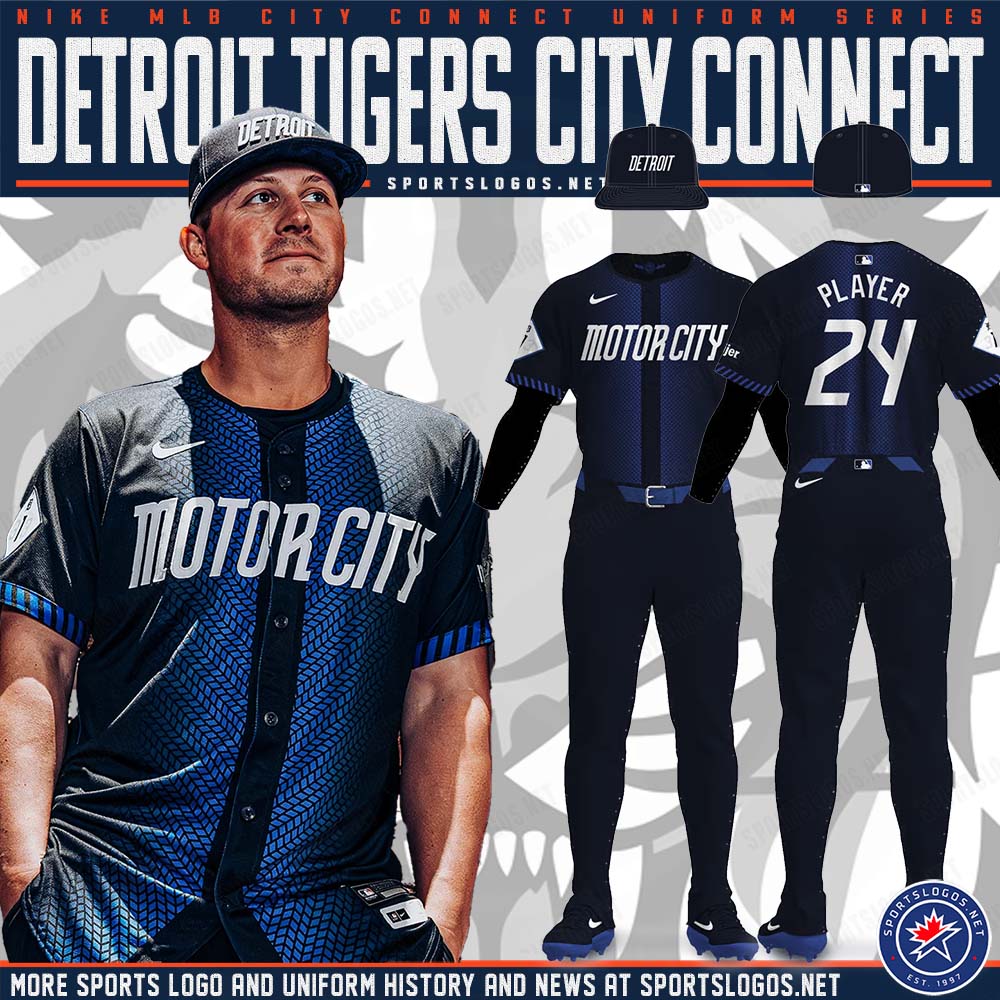
The Detroit Tigers have always been a franchise steeped in tradition, their uniforms a visual testament to baseball’s storied past. But in an era where teams are increasingly embracing bold, avant-garde designs to capture the zeitgeist, the Tigers’ latest offering—dubbed the City Connect jerseys—has ignited a debate that transcends the diamond. Are these uniforms a daring leap into the future, or a misstep that clings too tightly to convention? The answer may hinge on whether you see them as a bridge between eras or a detour from the team’s identity.
The Aesthetic Rebellion: What the City Connect Jerseys Actually Look Like
The new City Connect jerseys are a study in contrasts. The primary palette swaps the Tigers’ traditional navy and white for a striking electric blue, a hue that immediately commands attention. The team’s iconic Old English “D” is reimagined in a sleek, modern font, its curves softened to avoid the rigid militarism of its predecessor. Yet, the most polarizing element is the sleeve design—a geometric pattern that evokes the industrial grit of Detroit’s automotive heritage, a nod to the city’s blue-collar roots. Some see it as a masterstroke of thematic cohesion; others, a visual cacophony that clashes with the Tigers’ classic aesthetic. The jersey’s underside reveals a hidden detail: a subtle tiger stripe pattern lining the collar, a whisper of the team’s namesake that only reveals itself upon closer inspection. It’s a design choice that rewards scrutiny, but one that may go unnoticed in the blur of a fastball’s trajectory.
From Tradition to Trend: The Psychological Impact of Uniform Redesigns
Uniforms are more than fabric and thread—they’re psychological armor for players and a visual shorthand for fans. The Tigers’ shift from their hallowed navy and white to electric blue isn’t just a color change; it’s a psychological reset. Studies in sports psychology suggest that bold, unconventional uniforms can boost player confidence by fostering a sense of novelty and separation from the ordinary. For the Tigers, who have struggled with consistency in recent years, this could be a subtle psychological edge. Yet, the risk is equally potent: alienating a fanbase that prides itself on tradition. The electric blue may resonate with younger, more design-conscious audiences, but will it feel like a betrayal to lifelong supporters who see the Tigers’ uniforms as sacred relics? The answer lies in whether the team can sell the change as an evolution rather than a rupture.
The City Connect Concept: A Double-Edged Sword of Innovation
The MLB’s City Connect program was conceived as a way to honor each team’s regional identity through uniforms, but it’s become a playground for experimentation. For the Tigers, the challenge was to balance Detroit’s industrial legacy with the vibrancy of a modern metropolis. The result is a jersey that straddles two worlds: the grit of the assembly line and the sheen of a revitalized downtown. The geometric sleeve pattern, for instance, is a direct homage to the city’s automotive roots, but its abstract nature risks feeling like a corporate logo rather than a tribute. Meanwhile, the electric blue could be seen as an attempt to align with the trend of teams adopting non-traditional colors—see the Miami Marlins’ teal or the San Diego Padres’ camouflage—but it also risks blending in with the sea of blue that dominates sports uniforms. The question isn’t just whether the design works, but whether it *means* something to the people who wear it and cheer for it.
Fan Reactions: The Divide Between Nostalgia and Novelty
No uniform redesign is complete without fan reactions, and the Tigers’ City Connect jerseys have already sparked a schism. On one side, the purists decry the abandonment of tradition, arguing that the Tigers’ identity is built on their classic look. On the other, the modernists celebrate the boldness, seeing it as a long-overdue refresh. Social media has become a battleground of memes, hot takes, and even petitions—some calling the jerseys “futuristic,” others labeling them “a crime against baseball.” The divide isn’t just generational; it’s ideological. For those who see baseball as a museum piece, the jerseys are an affront. For those who view it as a living, evolving spectacle, they’re a breath of fresh air. The Tigers’ front office must now navigate this divide, ensuring that the jerseys don’t become a wedge between the team and its most loyal supporters.
Performance on the Field: Do Jerseys Affect Player Performance?
While the debate rages in the stands, the players themselves are the ultimate judges. Some athletes swear by the psychological boost of a new uniform, claiming it makes them feel sharper, more focused. Others dismiss the idea entirely, arguing that performance is dictated by skill, not fabric. For the Tigers, the City Connect jerseys could serve as a unifying symbol—a reminder that this team is forging a new path, even if the results on the field haven’t yet followed. But if the jerseys become a distraction, a source of second-guessing or self-consciousness, their impact could be negative. The true test will come during high-pressure moments: will a player feel invincible in electric blue, or will the weight of expectation become too heavy? The answer may lie in the team’s early performances with the new uniforms, where every hit, every strikeout, will be scrutinized through the lens of design.
The Broader Trend: Are City Connect Jerseys Here to Stay?
The Tigers’ City Connect jerseys are part of a larger movement in sports toward bold, themed uniforms. Teams are no longer content to blend into the background; they want to stand out, to tell a story, to be remembered. The success of the City Connect program will determine whether this trend is a passing fad or a permanent shift in sports aesthetics. If the Tigers’ jerseys are embraced, other teams may double down on experimental designs. If they’re rejected, we may see a return to more conservative choices. The stakes are high, not just for the Tigers, but for the entire league. Uniforms are the first impression a team makes on the world, and in an era where attention spans are shorter than ever, first impressions matter more than ever.
Conclusion: A Leap of Faith or a Step Too Far?
The Detroit Tigers’ City Connect jerseys are a gamble—a calculated risk that could redefine the team’s image or leave fans longing for the familiar. They are bold, unapologetic, and unmistakably Detroit in their attempt to marry the city’s past and present. Whether they succeed will depend on more than just aesthetics; it will require the team to embody the spirit of the jerseys on the field, in the stands, and in the hearts of its supporters. For now, they stand as a question mark, a challenge to convention, and a testament to the ever-evolving nature of sports. One thing is certain: baseball’s uniform wars are far from over, and the Tigers have just fired the first shot.