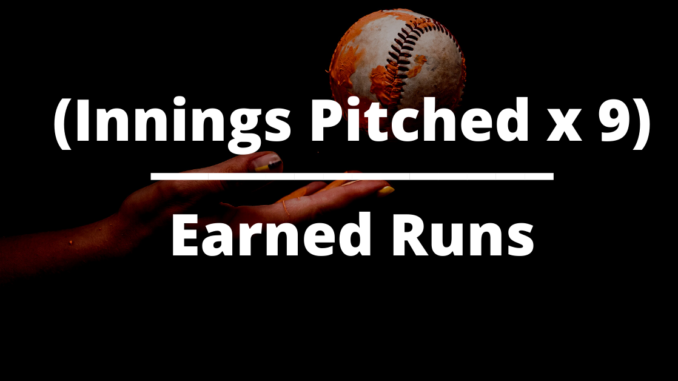
In the grand theater of baseball, where every pitch is a brushstroke on the canvas of competition, few statistics wield as much influence—or inspire as much debate—as the Earned Run Average, or ERA. It’s the metric that separates the mere mortals from the legends, the cold arithmetic that distills a pitcher’s artistry into a single, unforgiving number. But what does ERA truly signify? Is it merely a measure of runs allowed, or does it whisper secrets about the very soul of pitching?
The Alchemy of ERA: Turning Runs into a Number
At its core, ERA is a deceptively simple formula: the average number of earned runs a pitcher allows per nine innings. Earned runs, unlike their unearned counterparts, are those that result from a pitcher’s own missteps—base hits, walks, or errors that directly contribute to a runner crossing the plate. Unearned runs, often born from defensive miscues or inherited runners, are stripped away, leaving only the runs a pitcher can truly claim as his own.
This distinction is crucial. A pitcher’s ERA doesn’t just reflect his performance; it reflects his responsibility. It’s the difference between a pitcher who bends but doesn’t break under pressure and one who crumbles when the stakes are highest. The beauty of ERA lies in its precision—it doesn’t reward luck or defensive prowess, only the pitcher’s ability to prevent runs when it matters most.
The Three-Act Drama of a Pitching Performance
Every outing is a three-act play, and ERA is the epilogue that judges the narrative. The first act begins with the pitcher’s first pitch, where he must establish dominance over the opposing hitters. A high ERA in the early innings often signals a pitcher struggling to find his rhythm, his pitches betraying him like unruly actors in a poorly rehearsed play.
The second act is where the real test begins. Here, the pitcher must navigate the treacherous waters of opposing lineups, where even the slightest misstep can lead to a cascade of runs. A pitcher with a sub-3.00 ERA in this phase is a maestro, his pitches dancing around the edges of the strike zone like a fencer’s blade, leaving hitters grasping at air.
Finally, the third act arrives with the late innings, where the pressure mounts and the margin for error narrows. A pitcher who can maintain his composure here—keeping his ERA low even as fatigue sets in—is a true closer of the soul, his performance a testament to mental fortitude as much as physical skill.
The Paradox of ERA: A Stat That Lies by Telling the Truth
ERA is both a mirror and a mirage. It reflects a pitcher’s skill with unnerving accuracy, yet it can also distort reality when taken out of context. A pitcher with a 4.00 ERA in a hitter-friendly ballpark may be far more effective than one with a 3.50 ERA in a pitcher’s paradise. Context is the silent partner in the ERA equation, a reminder that numbers, no matter how precise, are never the whole story.
Consider the knuckleballer, whose erratic, dancing pitches defy conventional wisdom. His ERA might fluctuate wildly from start to start, yet his ability to confound hitters makes him invaluable. Or the groundball pitcher, whose low ERA belies the fact that he’s constantly putting runners on base—only for his defense to bail him out. ERA doesn’t account for these nuances, which is why it’s often paired with other metrics like Fielding Independent Pitching (FIP) or walks plus hits per inning pitched (WHIP) to paint a fuller picture.
The Psychological Weight of ERA: The Invisible Hand of Expectations
ERA isn’t just a statistic; it’s a psychological burden. Pitchers are judged by it, scrutinized for it, and often haunted by it. A single bad outing can inflate a pitcher’s ERA overnight, turning a season of dominance into a narrative of doubt. The pressure to maintain a low ERA can be suffocating, a constant reminder that every pitch could be the one that undoes months of hard work.
Yet, this pressure is also what makes ERA so fascinating. It’s not just a measure of skill—it’s a measure of resilience. The pitchers who thrive under this weight, who can shrug off a bad inning and refocus, are the ones who leave a lasting legacy. Their ability to compartmentalize failure is what separates the good from the great, and ERA is the scorecard that keeps them honest.
The Evolution of ERA: From Sandlot to Sabermetrics
ERA has been a cornerstone of baseball statistics since the early 20th century, but its interpretation has evolved alongside the game itself. In the dead-ball era, a 2.00 ERA was a mark of greatness, a testament to the pitcher’s ability to control the game with guile and precision. Today, in an era of launch angles and exit velocities, a 3.50 ERA might be considered elite.
Sabermetrics has further refined our understanding of ERA, introducing concepts like expected ERA (xERA) and skill-interactive ERA (SIERA) to account for factors like ballpark dimensions, defensive shifts, and even the quality of contact allowed. These advanced metrics don’t replace ERA; they contextualize it, offering a deeper dive into the mechanics of pitching success.
The game’s evolution has also given rise to new pitching strategies, from the rise of the bullpen to the increasing reliance on specialized relievers. A closer’s ERA, for instance, is often judged over a handful of innings, where the stakes are highest and the pressure is most intense. In this context, ERA becomes a measure of clutch performance, a way to quantify the intangible ability to rise to the occasion.
The Human Element: What ERA Can’t Measure
Despite its precision, ERA is a blunt instrument. It can’t capture the artistry of a pitcher’s repertoire, the way a curveball dips at the last moment or a changeup tails away from a hitter’s bat. It can’t measure the intangible qualities that make a pitcher a leader in the clubhouse or a mentor to younger players. ERA is a statistic, but baseball is a game of people—and people are infinitely more complex than numbers.
There’s also the matter of luck. A pitcher can induce weak contact that finds holes in the defense, or he can leave runners in scoring position only to watch them stranded. These fluctuations are part of the game, and ERA, for all its accuracy, can’t account for them. This is why even the most analytically inclined front offices balance ERA with other metrics, recognizing that the best pitchers are more than just their numbers.
The Legacy of ERA: A Stat That Defines Eras
ERA is more than a number—it’s a historical artifact. It tells the story of baseball’s changing dynamics, from the dominance of pitchers like Walter Johnson and Christy Mathewson in the early 1900s to the modern era, where pitchers like Clayton Kershaw and Jacob deGrom redefine what’s possible. It’s a stat that transcends generations, a constant thread woven through the fabric of the game.
For fans, ERA is a way to engage with the game on a deeper level. It invites debate, analysis, and appreciation for the nuances of pitching. For players, it’s a target to chase, a benchmark to measure their progress. And for the game itself, ERA is a reminder that baseball is as much about individual brilliance as it is about the collective effort of a team.
In the end, ERA is a window into the soul of pitching—a way to quantify the unquantifiable, to distill the chaos of a baseball game into a single, telling number. It’s not perfect, but then again, neither is baseball. And that’s what makes it so compelling.