In the labyrinthine world of sports memorabilia, where nostalgia often dictates value, one name stands out as a quiet disruptor: Hideo Nomo. The Japanese fireballer, with his unorthodox windup and pinpoint control, didn’t just dominate on the mound—he carved a niche in the hearts of collectors that transcends borders. Yet, despite his on-field heroics and cultural impact, Nomo’s baseball cards remain a well-kept secret, a hidden gem in a market saturated with overhyped modern stars. What if I told you that the key to a shrewd investment might not lie in the latest rookie cards of superstars, but in the overlooked legacy of a pitcher who redefined the game? Buckle up, because we’re about to peel back the layers of Hideo Nomo’s baseball card market—and what we uncover might just shift your perspective on collecting forever.
The Nomo Effect: Why His Cards Defy Market Trends
Baseball card collecting has always been a game of supply and demand, where scarcity and star power collide to create value. Yet Hideo Nomo’s cards operate in a league of their own, bucking the trends that dictate the market. While modern rookies and Hall of Famers dominate auctions, Nomo’s cards—particularly his rookie issues—have quietly appreciated in ways that defy conventional wisdom. The reason? Nomo wasn’t just another pitcher; he was a phenomenon. His 1995 debut with the Los Angeles Dodgers marked the first time a Japanese player had made a significant impact in Major League Baseball, and his success paved the way for a generation of international stars. This cultural milestone imbues his cards with a narrative weight that transcends mere athletic performance.
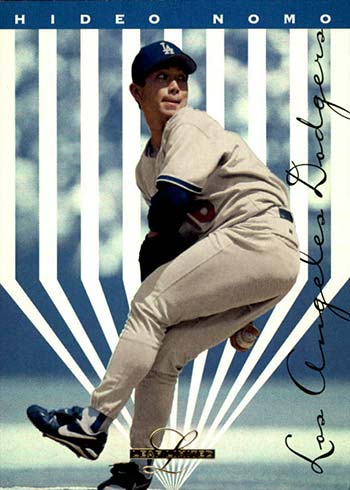
Consider the 1995 Leaf Limited Hideo Nomo Rookie Card. Unlike the glut of mass-produced inserts flooding the market today, this card is a relic of a bygone era—one where rookie cards were still a coveted prize rather than a dime-a-dozen commodity. Its value isn’t just tied to Nomo’s stats; it’s tied to the story of a man who bridged two baseball worlds. Collectors aren’t just buying cardboard; they’re investing in a piece of history that captures the dawn of a new era in the sport. And in a market where authenticity and provenance are king, Nomo’s cards offer something rare: a tangible connection to a transformative moment in baseball.
Grading Matters: The Subtle Art of Condition Scrutiny
If you’ve ever dipped your toes into the sports card market, you know that condition is everything. A Nomo card in pristine PSA 10 gem mint condition can fetch upwards of $1,000, while a well-loved PSA 7 might struggle to crack $100. But here’s the twist: the difference between a 9 and a 10 isn’t just about eye appeal—it’s about the story the card tells. A Nomo rookie in high grade isn’t just a collectible; it’s a museum piece, a frozen moment in time that captures the essence of a player who was as much a cultural icon as he was an athlete.
The grading process for Nomo’s cards is particularly nuanced because of their age. Many 1995 issues were handled roughly, stored in less-than-ideal conditions, or simply fell victim to the wear and tear of time. This means that high-grade examples are exceptionally scarce, creating a supply bottleneck that drives value. But grading isn’t just about the numbers on a card’s surface; it’s about the subtleties that separate the extraordinary from the ordinary. A sharp centering, vibrant colors, and crisp edges can elevate a Nomo card from desirable to downright legendary. For collectors, this means that the hunt for a perfect slab isn’t just a quest for investment—it’s a labor of love.
And let’s not forget the role of authentication. In an era where fakes and reprints proliferate, a graded Nomo card carries the imprimatur of trust. Companies like PSA and BGS don’t just slap a number on a card; they validate its journey through time, ensuring that what you’re holding is the real deal. This layer of security adds another dimension to the value proposition, making high-grade Nomo cards not just collectibles, but veritable trophies of the hobby.
Rarity and Editions: The Hidden Multipliers
Not all Nomo cards are created equal, and that’s where the real magic lies. The 1995 Leaf Limited set, for instance, is a masterclass in controlled scarcity. Unlike the endless churn of modern parallels and serial-numbered inserts, Leaf Limited was a limited-run product designed to appeal to collectors who craved exclusivity. The result? A card that’s as much about the set’s design as it is about Nomo himself. The scarcity of these early issues means that even common variants can command premiums, while the chase for the elusive autographed versions becomes a holy grail for enthusiasts.
Then there’s the matter of regional variations. Nomo’s cards were produced for both the U.S. and Japanese markets, and the differences—whether in design, print quality, or even language—can turn a seemingly identical card into a prized possession. A Japanese-exclusive Nomo card, for example, might feature alternate artwork or bilingual text, adding a layer of intrigue that appeals to niche collectors. These variations aren’t just novelties; they’re proof that the card market is as much about storytelling as it is about numbers.
But rarity isn’t just about what’s printed—it’s about what survives. Many Nomo cards from the mid-90s were produced in an era before collectors fully grasped the long-term value of their hobby. As a result, high-grade examples are increasingly difficult to find, and when they do surface, they often spark bidding wars that defy logic. This scarcity multiplier is the secret sauce that turns a Nomo card from a simple collectible into a potential goldmine.
The Investment Angle: Why Nomo Cards Could Be the Sleeper Hit of the Decade
Let’s talk turkey: is investing in Hideo Nomo’s baseball cards a smart move? The short answer is yes—but with caveats. The long answer is far more compelling. Nomo’s cards occupy a sweet spot in the market: they’re not so rare that they’re out of reach for the average collector, but they’re scarce enough to have appreciated steadily over the years. Unlike the boom-and-bust cycles that plague modern rookie cards, Nomo’s market has shown remarkable resilience, with prices climbing even during downturns in the broader hobby.
Consider the trajectory of his rookie cards. In 2010, a PSA 9 1995 Leaf Nomo could be had for around $200. Fast-forward to 2023, and the same card fetches $800 or more. That’s a 300% increase in just over a decade—a performance that outpaces many blue-chip investments. And with Nomo’s legacy still growing—inducted into the Japanese Baseball Hall of Fame in 2014, his cards are gaining renewed attention from international collectors who see him as a bridge between two baseball cultures.
The key to maximizing your investment lies in diversification. While the 1995 Leaf Limited rookie is the crown jewel, other Nomo issues—like his 1995 Bowman or Topps cards—offer more accessible entry points. These cards often trade at a fraction of the price of his premium rookies but have shown similar appreciation trends. For the savvy collector, this presents an opportunity to build a portfolio that balances risk and reward, with Nomo as the anchor.
But here’s the kicker: Nomo’s cards aren’t just a play on his on-field success. They’re a bet on nostalgia, on the enduring appeal of a player who defied expectations and changed the game. In a market where collectors are increasingly drawn to cards that tell a story, Nomo’s issues offer a narrative that’s as rich as it is rare. And in an era where authenticity and provenance are king, his cards provide a tangible link to a transformative moment in baseball history.
The Future of Nomo Cards: What’s Next for the Market?
The million-dollar question: where do Hideo Nomo’s baseball cards go from here? The answer lies in a combination of factors that could propel his cards to new heights. First, there’s the undeniable pull of nostalgia. As millennials and Gen Z collectors rediscover the magic of the 90s, Nomo’s cards are perfectly positioned to capitalize on that wave. His rookie cards, in particular, evoke a sense of simpler times—a era before social media, before the internet, before baseball became a 24/7 spectacle. For a generation raised on digital collectibles, the tactile appeal of a Nomo card is a breath of fresh air.
Then there’s the international angle. Nomo’s cards have always had a strong following in Japan, but as the global baseball card market continues to expand, his appeal is reaching new audiences. Japanese collectors, in particular, are increasingly looking to the U.S. market for rare and historic cards, creating a cross-pollination of demand that could drive prices even higher. Imagine a scenario where a Japanese collector and an American investor lock horns in a bidding war over a PSA 10 Nomo rookie—it’s not far-fetched, and it’s a dynamic that could reshape the market.
Finally, there’s the role of pop culture. Nomo’s impact extended beyond baseball; he was a global icon, a symbol of the sport’s international growth. As documentaries, biographies, and even video games continue to explore his legacy, his cards stand to benefit from the halo effect. Think of it as the “Michael Jordan effect”—where a player’s cultural footprint elevates the value of his memorabilia. Nomo may not have Jordan’s six rings, but his influence on the game is no less profound.
The story of Hideo Nomo’s baseball cards is, at its core, a story about legacy. It’s about a player who didn’t just play the game—he changed it, and in doing so, created a collectible that transcends the hobby’s usual trappings. His cards aren’t just investments; they’re artifacts, relics of a time when baseball was as much about artistry as it was about athleticism. And in a market that’s increasingly dominated by flash and hype, Nomo’s cards offer something rare: substance. They’re a reminder that the best collectibles aren’t just about what they’re worth today—they’re about what they represent for tomorrow. So, if you’ve been searching for a card that offers both financial upside and a compelling narrative, look no further. The Nomo effect is real, and it’s just getting started.