In the pantheon of football collectibles, few rookie cards command the reverence—or the price tags—of those featuring Steve Young. The former San Francisco 49ers legend, a Hall of Famer whose cannon arm and scrambling genius redefined the quarterback position, has left an indelible mark on the sport. But it’s not just his on-field heroics that fascinate collectors; it’s the tangible artifacts of his early career, particularly his rookie cards, that have become the stuff of legend. Whether tucked away in a shoebox or nestled in a climate-controlled display case, these cards are more than mere pieces of cardboard. They are portals to a bygone era, when the USFL still posed a threat to the NFL’s dominance, and when a young, unproven signal-caller from BYU was about to rewrite the playbook of quarterbacking itself.
For the uninitiated, the term “rookie card” might evoke images of glossy, mass-produced trinkets, but in the world of sports memorabilia, they are the first tangible link between a player’s past and their legacy. Steve Young’s rookie cards, scattered across different sets and manufacturers, are not just collectibles—they are historical documents, each with its own story to tell. Some are common, found in every pack of their respective series; others are so scarce that even seasoned dealers gasp when one surfaces. The disparity in their rarity is a reflection of the tumultuous times in which they were issued, a period when the football card industry was as fluid as the leagues themselves. The USFL’s brief but fiery existence, for instance, left behind a trail of cards that today are prized for their historical significance as much as their condition.
The 1984 Topps USFL Steve Young RC: A Relic of a Fleeting Era
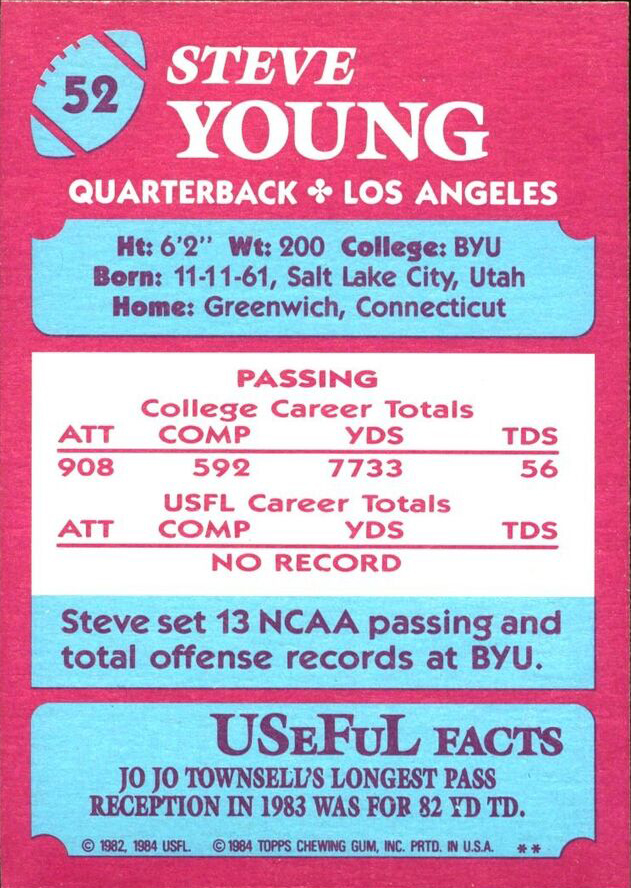
The 1984 Topps USFL Steve Young rookie card is the kind of card that makes collectors’ hearts race. Issued during the league’s second season, when the upstart circuit was still luring talent with promises of riches and prime-time exposure, this card captures a moment when Young was just beginning to turn heads. His time with the Los Angeles Express was marked by flashes of brilliance, though the team’s struggles often overshadowed his individual performances. Yet, for collectors, the card’s value lies not in the player’s immediate success but in its status as a time capsule. The USFL’s collapse in 1986, just two years after this card’s release, turned many of its issues into instant rarities. Today, a high-grade copy of Young’s USFL rookie can fetch thousands, a testament to the league’s brief but impactful legacy.
The card itself is a study in contrasts. On one side, Young’s youthful exuberance is palpable, his arm cocked back in mid-throw, the iconic Topps design framing him in bold, primary colors. On the reverse, the player bio reads like a footnote in history, a reminder of a league that dared to challenge the NFL’s monopoly. The scarcity of high-grade examples is no accident; the USFL’s financial woes meant that production runs were often inconsistent, and many cards were subjected to the wear and tear of a fanbase that was just as quickly abandoned as it had been courted. For those who own one, it’s not just a card—it’s a piece of a forgotten revolution.
The 1986 Topps Steve Young Rookie Card: The Mainstream Icon
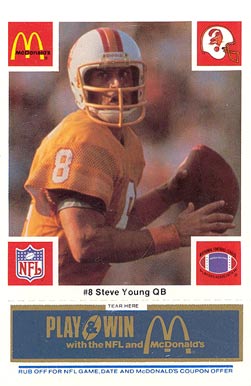
If the USFL card is a relic of a forgotten war, the 1986 Topps Steve Young rookie card is the mainstream monument. Released after Young’s transition to the NFL, where he would eventually inherit the 49ers’ mantle from Joe Montana, this card is the one most fans recognize. It’s the card that adorns the pages of price guides, the one that appears in auction listings with the kind of frequency that suggests ubiquity—but don’t be fooled. While it may be more common than its USFL counterpart, its value is anything but ordinary. The key lies in the details: centering, corners, and surface wear can turn a $20 card into a $200 treasure in the blink of an eye.
What makes this card particularly fascinating is its role in documenting Young’s journey from a promising but unproven talent to a future Hall of Famer. The 1986 Topps set was a transitional one, a bridge between the classic designs of the early 1980s and the modern, flashier aesthetics that would dominate the decade. Young’s card, with its simple yet effective layout, captures the essence of that era. The photo, taken during his rookie season with the Tampa Bay Buccaneers, shows a player on the cusp of greatness, his gaze fixed with the quiet intensity of someone who knows he’s destined for more. For collectors, the card’s appeal is twofold: it’s a snapshot of a career in its infancy, and it’s a tangible link to the NFL’s golden age, when legends were made in the trenches and in the backfields.
Grading and Authentication: The Gatekeepers of Value
In the world of sports cards, condition is king. A Steve Young rookie card in gem mint condition isn’t just a collectible—it’s a museum piece. But how do collectors determine what’s truly valuable? The answer lies in grading, a process that has evolved from a subjective art into a science governed by stringent standards. Companies like PSA, BGS, and SGC have become the arbiters of value, their slabs of plastic and paper serving as stamps of approval—or condemnation. A card graded PSA 10, the highest possible, can be worth ten times more than its ungraded counterpart, a fact that has turned grading into a high-stakes industry of its own.
The grading process is exhaustive. Centering, which measures how perfectly the image is aligned on the card, is scrutinized under a loupe. Corners, edges, and surface wear are examined for the slightest imperfections. Even the card’s print quality, ink density, and gloss can affect its final grade. For Steve Young’s rookie cards, the difference between a PSA 9 and a PSA 10 can mean the difference between a comfortable retirement fund and a weekend splurge. But grading isn’t just about assigning a number—it’s about preserving history. Each graded card is a frozen moment in time, a snapshot of a player’s legacy preserved for future generations.
Authentication is another critical layer in the world of collectibles. Counterfeit cards have proliferated in the digital age, with high-quality scans and reprints making it easier than ever to dupe unsuspecting buyers. For Steve Young’s rookie cards, the stakes are particularly high. The USFL card, with its limited production run, is a prime target for forgers, while the 1986 Topps card’s ubiquity makes it a tempting canvas for tampering. Collectors must rely on a combination of provenance, holograms, and expert verification to ensure their cards are the real deal. In a market where trust is currency, authentication is the ultimate safeguard.
Market Trends: Why Steve Young’s Cards Are More Than Just Nostalgia
The value of Steve Young’s rookie cards isn’t just a matter of nostalgia—it’s a reflection of the broader trends shaping the sports memorabilia market. In recent years, the hobby has undergone a seismic shift, with younger generations embracing cards as both investments and cultural artifacts. The rise of online marketplaces like eBay and Heritage Auctions has democratized access to collectibles, while platforms like PSA’s auction portal have turned grading into a spectator sport. For Steve Young’s cards, this has meant a steady appreciation in value, driven by a combination of supply and demand, historical significance, and the player’s enduring legacy.
But the market’s fascination with Young’s rookie cards goes deeper than mere financial gain. There’s something inherently human about the desire to own a piece of the past, to hold in your hands a tangible connection to a player who thrilled fans decades ago. In an era of digital consumption, where highlights are reduced to 15-second clips and statistics are parsed by algorithms, a rookie card is a tactile reminder of a time when football was as much about artistry as it was about analytics. Young’s cards, with their vivid imagery and palpable history, offer a respite from the ephemeral nature of modern sports fandom.
The market’s appetite for Young’s cards is also a testament to his place in football lore. While he may never have achieved the same level of mainstream recognition as contemporaries like Dan Marino or John Elway, Young’s impact on the game is undeniable. His dual-threat ability, honed in the USFL and perfected in the NFL, foreshadowed the modern quarterback revolution. Collectors who own his rookie cards aren’t just investing in cardboard—they’re investing in a piece of football’s evolutionary history.
The Hidden Gems: Lesser-Known Steve Young Cards Worth Your Attention
While the 1984 USFL and 1986 Topps cards are the stars of the show, they’re not the only Steve Young rookie cards worth owning. The hobby is full of underrated gems, cards that fly under the radar but offer incredible value for the discerning collector. Take, for example, the 1984 Pro Set Steve Young rookie card. Issued during the USFL’s inaugural season, this card is often overlooked in favor of its Topps counterpart, but its scarcity and distinctive design make it a worthy addition to any collection. Similarly, the 1985 Fleer Steve Young rookie card, while not as iconic as the Topps issues, is a beautiful example of Fleer’s early-1980s aesthetic, with a portrait-style photo that highlights Young’s youthful charm.
Another hidden gem is the 1986 McDonald’s Steve Young rookie card. Part of a fast-food promotion that distributed cards in Happy Meals, this card is a true oddity. Its small size and unconventional distribution method make it a challenge to find in high grade, and its playful design—a stark contrast to the more serious tone of Topps and Fleer—adds a layer of charm. For collectors who appreciate the quirky side of the hobby, the McDonald’s card is a must-have.
Even within the major sets, there are variations that can turn a common card into a prized possession. The 1986 Topps Steve Young rookie card, for instance, exists in both a standard version and a “Tiffany” variation, which features a higher-quality stock and sharper print. While the Tiffany version is rare, it’s not impossible to find, and its premium can be substantial. Similarly, the 1984 Topps USFL card has multiple print runs, with some variations showing subtle differences in color saturation or border width. These nuances may seem minor, but to the trained eye, they’re the difference between a common card and a collector’s holy grail.
For those willing to dig deeper, the world of Steve Young rookie cards offers a treasure trove of opportunities. Whether it’s a regional issue from a minor league or a promotional card from a defunct fast-food chain, the key is to look beyond the obvious. The most valuable cards aren’t always the ones with the highest print runs or the most recognizable designs—they’re the ones with a story to tell.
Steve Young’s rookie cards are more than just collectibles; they are windows into a pivotal era of football history. From the fleeting ambition of the USFL to the mainstream dominance of the NFL, these cards document a career that reshaped the quarterback position. For collectors, they offer a tangible connection to a player whose legacy transcends statistics and highlights. Whether you’re a seasoned investor or a casual fan, the hunt for these hidden gems is a journey worth taking. And who knows? The card you’ve been holding onto for years might just be the key to unlocking a fortune—or at least a very impressive conversation starter.