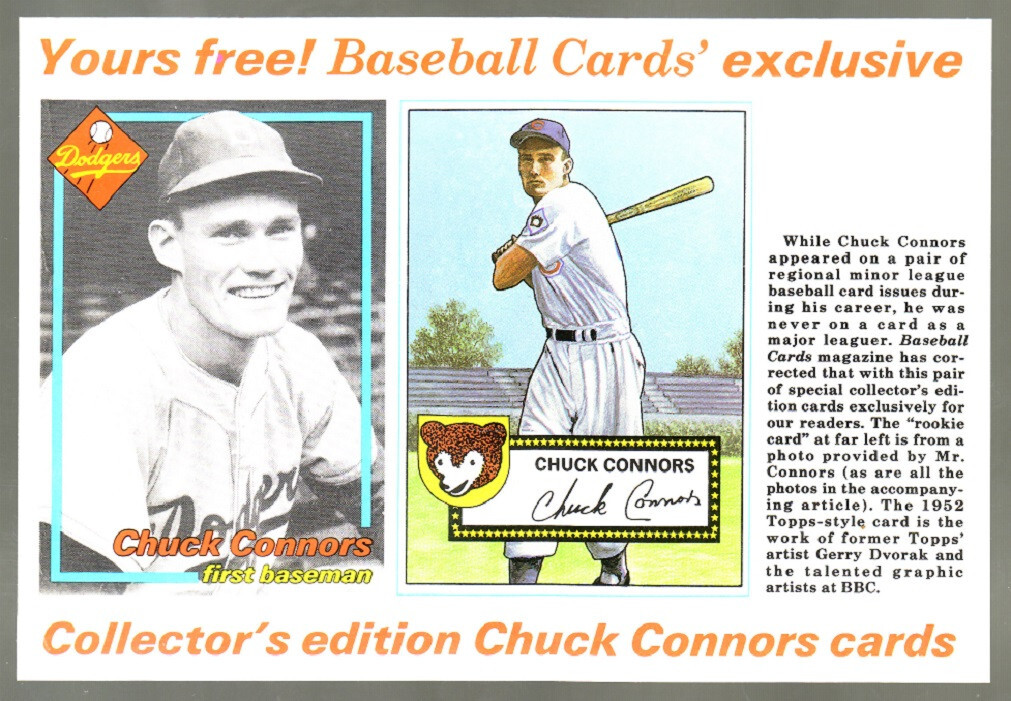
In the grand tapestry of baseball memorabilia, where leather-bound gloves and yellowed scorecards often steal the spotlight, there exists a relic that whispers of a bygone era—one where the crack of a bat echoed through dusty ballparks and heroes were forged in the fires of competition. The Chuck Connors Baseball Card, emblazoned with the name “The Rifleman” and dated to a style reminiscent of 1952, is not merely a piece of cardboard encased in plastic. It is a portal to a time when America’s pastime was as much about storytelling as it was about sport, a tangible fragment of a legend who straddled two worlds with the effortless grace of a man who had mastered both the diamond and the silver screen.
Imagine, if you will, holding this card between your fingers. The edges are slightly worn, as if it has been passed down through generations of collectors, each one adding a layer of history to its patina. The ink, though faded by decades of sunlight and scrutiny, still bears the unmistakable imprint of an era when baseball cards were as much about artistry as they were about statistics. The portrait of Chuck Connors—tall, broad-shouldered, with a gaze that seems to pierce through the decades—captures a man who was as comfortable swinging a bat as he was wielding a rifle in the role that would define his legacy. This card is not just a collectible; it is a time capsule, a frozen moment where the raw energy of the game collides with the mythic allure of Hollywood.
The Duality of a Legend: From Diamond to Silver Screen
Chuck Connors was a man of contradictions, a paradox wrapped in the guise of a rugged American hero. Before he became the stoic Lucas McCain in The Rifleman, a television Western that would cement his place in pop culture, he was a professional athlete—a first baseman for the Boston Red Sox in 1949. His baseball career, though brief, was marked by a raw talent that hinted at greatness, a left-handed swing that could send a ball soaring into the outfield with the kind of authority that made pitchers tremble. Yet, fate had other plans. The diamond was only the first act of his story.
By the time this baseball card was produced, Connors had already begun his metamorphosis from athlete to actor, a transition that was as audacious as it was unexpected. The card itself is a testament to this duality. On one side, the uniform-clad Connors stares back at you, his posture exuding the quiet confidence of a man who had already tasted the thrill of victory on the field. On the other, the title “The Rifleman” hints at the role that would overshadow his athletic achievements. It’s a fascinating juxtaposition—one that mirrors the way Connors himself bridged two worlds, each feeding off the other in a symbiotic dance of skill and charisma.
The card’s design, with its bold typography and sepia-toned aesthetic, evokes the golden age of baseball cards, when tobacco companies and gum manufacturers turned athletes into icons. Yet, there’s something almost prophetic about this particular card. It was minted at a time when Connors was on the cusp of leaving the dugout for the soundstage, a transition that would redefine his legacy. In hindsight, it’s as if the card itself knew that its subject was destined for greater things, that the man in the photograph would one day become synonymous with the very essence of American frontier spirit.
The Aesthetic Alchemy: Why This Card Captivates Collectors
Baseball cards are, at their core, miniature works of art—each one a carefully crafted blend of photography, design, and nostalgia. The Chuck Connors card, however, possesses a je ne sais quoi that elevates it beyond the ordinary. The composition is masterful: Connors is captured mid-pitch, his body coiled like a spring, his expression a mix of determination and focus. The photographer has managed to freeze a moment that feels alive, as if the next frame would show the ball hurtling toward the batter with the speed of a bullet.
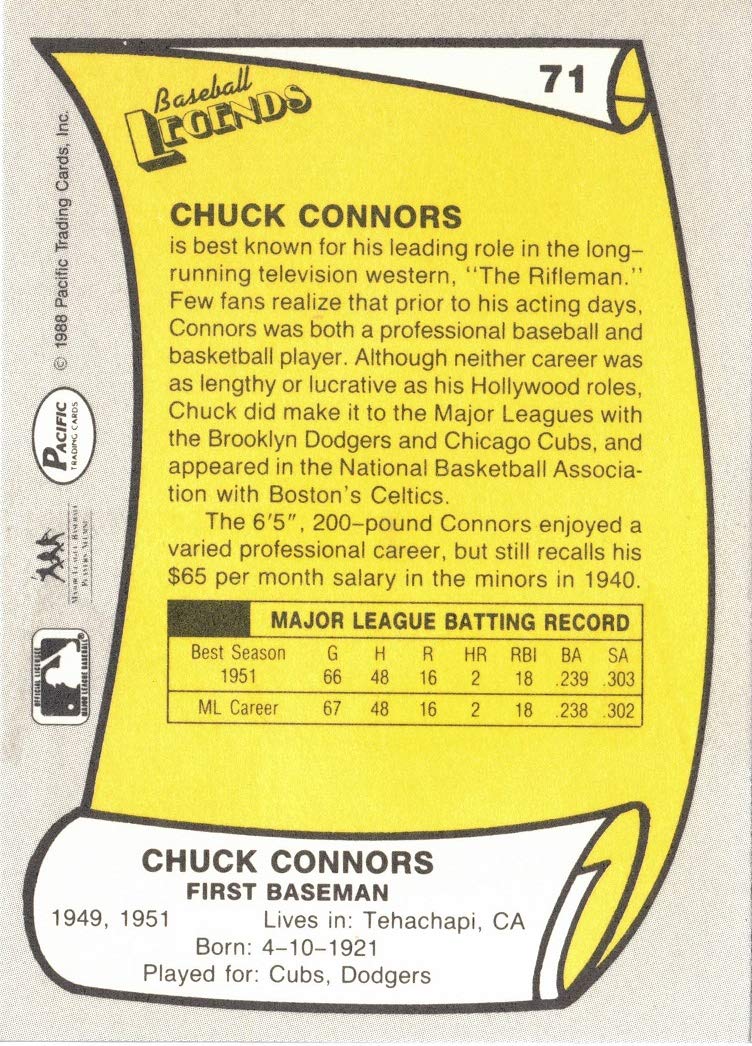
The color palette is another layer of its allure. The sepia tones lend the card a timeless quality, as if it has been plucked from the archives of history itself. The browns and ambers are not merely decorative; they evoke the warm, nostalgic glow of a bygone era, a visual echo of the radio broadcasts and newspaper clippings that once chronicled the game. Even the typography—bold, blocky, and slightly weathered—feels like a shout from the past, a reminder that this card is not just a collectible but a relic of a time when baseball was the undisputed king of American entertainment.
For collectors, the appeal of this card lies in its rarity and its story. Unlike the mass-produced cards of today, which flood the market in endless variations, this card feels handcrafted, as if each one was lovingly produced for a select few. The fact that it bridges two of Connors’ most iconic roles—athlete and actor—adds a layer of intrigue that is hard to quantify. It’s not just a card; it’s a conversation starter, a piece of history that invites you to delve deeper into the life of a man who lived two lives with equal parts passion and prowess.
The Market’s Whisper: Why This Card is a Hidden Gem
The world of sports memorabilia is a labyrinth of value, where the worth of a card is dictated by a complex alchemy of rarity, demand, and provenance. The Chuck Connors Baseball Card, while not as ubiquitous as a Mickey Mantle or a Babe Ruth, holds a unique position in this ecosystem. Its value is not merely in its condition or its age, but in the mythos that surrounds its subject. Connors’ dual legacy—one foot in the batter’s box, the other in the Wild West—makes this card a coveted piece for those who appreciate the intersection of sports and pop culture.
Consider the psychology of the collector. For some, the card is a trophy, a tangible connection to a player who never quite reached the hallowed halls of Cooperstown but whose impact on the game is undeniable. For others, it’s a piece of Americana, a slice of history that encapsulates the spirit of the 1950s, when baseball was America’s favorite pastime and television was just beginning to weave its spell on the nation’s consciousness. The card’s value, then, is not just monetary; it’s emotional, a bridge between generations of fans who see in Connors a reflection of their own dreams and aspirations.
Rarity also plays a role. While baseball cards from the early 1950s are not as scarce as those from the pre-war era, the Connors card stands out due to its dual association with two distinct worlds. It’s a card that appeals to baseball purists and Western enthusiasts alike, a rare bird that straddles two niches. In an era where collectors are increasingly seeking out unique and multifaceted pieces, this card fits the bill perfectly. It’s not just a relic of the diamond; it’s a cultural artifact, a small but significant piece of the puzzle that is American history.
The Legacy Lives On: How This Card Keeps the Spirit Alive
Baseball cards are more than ink and cardboard; they are vessels of memory, tiny time machines that transport us to moments we never lived but feel as if we did. The Chuck Connors card is no exception. It keeps alive the memory of a man who was, in many ways, a pioneer—a man who proved that the boundaries between sports and entertainment were not as rigid as they seemed. In an age where athletes are often typecast into narrow roles, Connors’ journey from the mound to the frontier is a reminder that greatness is not confined to a single arena.
For younger generations, this card offers a glimpse into a world that feels almost mythical. The sepia tones, the vintage design, the name “The Rifleman” emblazoned across the front—it’s all a portal to a time when heroes were larger than life, when a man could be both an athlete and an actor, a sportsman and a storyteller. In an era of hyper-specialization, where careers are often confined to a single path, Connors’ dual legacy feels like a breath of fresh air, a testament to the boundless potential of the human spirit.

Even the card’s physicality contributes to its legacy. The slight wear and tear, the faded edges, the creases that tell a silent story of its journey through time—all of these imperfections are not flaws but testaments to its authenticity. A mint-condition card might fetch a high price, but a card that has lived, that has been held and admired and passed down, carries a soul that no pristine copy can replicate. It’s a reminder that history is not meant to be preserved in a vacuum; it’s meant to be experienced, to be touched, to be felt.
The Chuck Connors Baseball Card is more than a collectible; it is a symphony of history, art, and legend. It captures a moment when a man stood at the crossroads of two extraordinary careers, when the crack of a bat and the ring of a rifle were two sides of the same coin. To hold this card is to hold a piece of the past, a fragment of a story that continues to resonate with each passing generation. In a world where the new and the shiny often overshadow the old and the venerable, this card is a quiet rebellion—a reminder that the past is not just a place we visit, but a place we carry with us, always.