Baseball is a game of precision, strategy, and endurance, where the pitcher’s arm is both the weapon and the vulnerability. From the first tosses in Little League to the high-stakes pitches of Major League Baseball, the rules governing how many pitches a player can throw—known as pitch counts—evolve dramatically. These regulations aren’t arbitrary; they’re carefully calibrated to protect young arms from overuse, prevent injuries, and nurture talent responsibly. Understanding how pitch counts change with age reveals a fascinating journey from youthful exuberance to professional discipline, where each stage demands a different approach to pitching. Whether you’re a parent, coach, or aspiring player, grasping these nuances can shape a career—or at least keep a young arm healthy.
The Foundations: Pitch Counts in Little League Baseball (Ages 4–12)
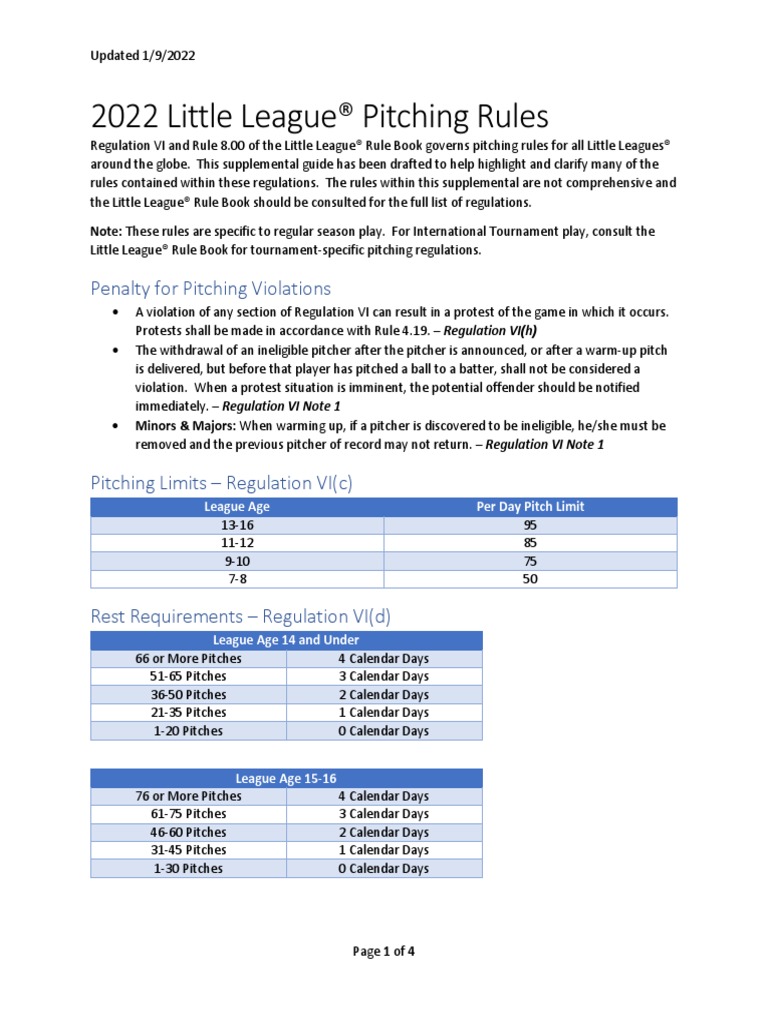
In the earliest stages of baseball, the focus isn’t on velocity or strikeouts but on fun, fundamentals, and fostering a love for the game. Little League Baseball, the most iconic youth league, sets pitch count limits that prioritize safety over performance. For players aged 7–8, the maximum is typically 50 pitches per game, with a mandatory rest period of 1–2 days depending on the total thrown. As players mature into the 9–10 age bracket, the limit rises to 75 pitches, acknowledging their growing physical capacity while still emphasizing caution.
For 11–12-year-olds, the threshold increases to 85 pitches, but the rules become more nuanced. Coaches must track pitches meticulously, and exceeding the limit can result in suspensions. The rationale is clear: young arms are still developing, and the repetitive stress of pitching—especially curveballs and sliders—can lead to serious injuries like Tommy John surgery. These restrictions aren’t just about compliance; they’re about instilling habits that will carry into higher levels of play. A pitcher who learns to pace themselves early is less likely to burn out before high school.
Adolescent Arm Care: Pitch Counts in Middle and High School (Ages 13–18)
The transition from Little League to high school baseball marks a significant shift in pitch count regulations. At this stage, players are stronger, but their bodies are still maturing, making them susceptible to overuse injuries. Most high school leagues adhere to the National Federation of State High School Associations (NFHS) guidelines, which cap pitches at 105 per game for 13–14-year-olds and 120 for 15–18-year-olds. However, these numbers come with caveats: pitchers who throw 76 or more pitches in a game must rest for three days, while those throwing 26–50 pitches need just one day of rest.
This tiered system reflects a deeper understanding of recovery. Adolescent pitchers often balance school, sports, and social lives, leading to a temptation to play through fatigue. But the body’s ability to recover doesn’t scale linearly with age. A 16-year-old’s arm might handle 120 pitches in a game, but if they pitch again three days later, the cumulative stress could lead to microscopic tears in the ulnar collateral ligament. Coaches and parents must enforce these rules rigorously, even when the pressure to win is intense. The goal isn’t just to avoid injuries but to cultivate pitchers who can sustain their performance over years, not just weeks.
The Professional Grind: Pitch Counts in Minor and Major League Baseball
By the time a player reaches Minor League Baseball (MiLB), the pitch count isn’t just a guideline—it’s a science. Teams employ pitching coaches, sports scientists, and even wearable technology to monitor every throw. In the minors, pitch limits are often individualized, based on a player’s workload history, mechanics, and recovery metrics. A pitcher might be limited to 80 pitches in a start, with strict adherence to rest days between outings. The stakes are higher here; a minor leaguer’s career can hinge on avoiding the disabled list.
In Major League Baseball, the pitch count becomes a strategic tool as much as a protective measure. Managers and pitching coaches use pitch counts to manage bullpen arms, prevent fatigue, and exploit matchups. A starter might be pulled after 90–100 pitches, even if they’re cruising, because the risk of decline outweighs the potential reward. Relief pitchers, meanwhile, are often limited to 20–30 pitches per appearance to maintain maximum velocity and spin rates. The MLB’s pitch clock, introduced in 2023, adds another layer of complexity, forcing pitchers to adapt their pace while staying within their physical limits.
This professional approach highlights a critical shift: pitch counts are no longer just about safety but about optimization. Every pitch is a calculated decision, balancing performance against preservation. It’s a far cry from the carefree days of Little League, where the biggest concern was whether the coach would let you pitch the entire game.
Special Considerations: Curveballs, Sliders, and the Art of Pitching
Not all pitches are created equal, and neither are their risks. Curveballs and sliders, with their sharp breaking movements, place immense torque on a pitcher’s elbow and shoulder. Studies have shown that these pitches are more likely to cause injuries in young arms, leading many youth leagues to ban them outright for players under 14. Even in high school and college, coaches often restrict their use, favoring fastballs and changeups as safer alternatives.
The mechanics of pitching also play a role in pitch count decisions. A pitcher with poor form—such as overstriding or dropping their elbow—is more likely to suffer an injury, regardless of their pitch count. This is why many programs incorporate biomechanical analysis into their training, using high-speed cameras and force plates to identify inefficiencies. A pitcher with pristine mechanics might handle 120 pitches in a game, while another with flawed form could struggle after 60. The lesson is clear: pitch counts are just one piece of the puzzle. Proper technique and workload management are equally vital.
The Psychological Impact: Pressure, Performance, and Burnout
Pitch counts aren’t just a physical constraint; they’re a psychological one. Young pitchers often grapple with the pressure to perform, especially in high-stakes games. A coach’s decision to pull a pitcher after 85 pitches can feel like a vote of no confidence, even if it’s the right call. This mental toll is why sports psychologists emphasize the importance of framing pitch limits as protective measures rather than punishments. A pitcher who understands the rationale behind the rules is more likely to embrace them.
Burnout is another silent killer of young pitching careers. The grind of pitching every weekend, combined with the demands of school and social life, can lead to disillusionment. Many elite pitchers peak in high school, only to lose their passion by college. To combat this, some programs incorporate “pitching holidays” or limit the number of games a player can pitch in a season. The goal isn’t just to produce winners but to sustain lifelong athletes who enjoy the game.
Looking Ahead: The Future of Pitch Counts in Baseball
The evolution of pitch count regulations reflects broader trends in sports science and athlete welfare. Wearable technology, such as smart sleeves and motion-tracking sensors, is already being used to monitor workload in real time. In the future, these tools could provide personalized pitch limits based on a player’s biomechanics, fatigue levels, and recovery capacity. Artificial intelligence might even predict injury risks before they occur, allowing teams to adjust their strategies proactively.
There’s also a growing movement to standardize pitch count rules across all levels of baseball. Currently, regulations vary widely between youth leagues, high schools, colleges, and pros, creating confusion for players transitioning between levels. A unified system—perhaps modeled after MLB’s pitch clock—could simplify the process and ensure consistent protection for pitchers at every stage.
Ultimately, the story of pitch counts is a story of balance. It’s about finding the sweet spot between competition and care, between performance and preservation. From the first underhand tosses in Little League to the 100-mph fastballs in the majors, each pitch is a testament to the player’s skill—and the system’s wisdom in protecting it.